

PREVIOUSLY...
At Alder Lake Campground, the last big weekend of summer had begun with a water bomber skimming the lake. Diane Vautrin, the campground manager, had kept her eyes instead on a column of smoke climbing into the sky. Her son Étienne had come back to help. Open fires had been banned, the fireworks replaced by a drone show entrusted to Malik Desrosiers, and Zoé Bell had planned a hike with Ana and Milo toward the old road and its condemned bridge. By evening, the radio had given the phenomenon a name: a pyrocumulonimbus, a thunderstorm generated by wildfire. Then lightning had burst from the smoke.
• • •
Diane had not slept.
She had closed her eyes in intervals, just long enough to lose track of the time. Each time she opened them again, the lake made the same sound against the docks: three small knocks, a pause, then three more. Moored hulls chimed softly in the dark.
At five twenty, she gave up.
The sun was not up, but the room was no longer dark. Gray light filtered through the curtains, too even to be dawn. Diane put her feet on the floor and sat for a moment on the edge of the bed.
In the silence, the campground was already alive.
A refrigerator motor started behind a wall. A water pump shuddered through a pipe. Farther away, someone coughed twice, then carefully closed a car door.
The world was still working.
Diane pulled back the curtain.
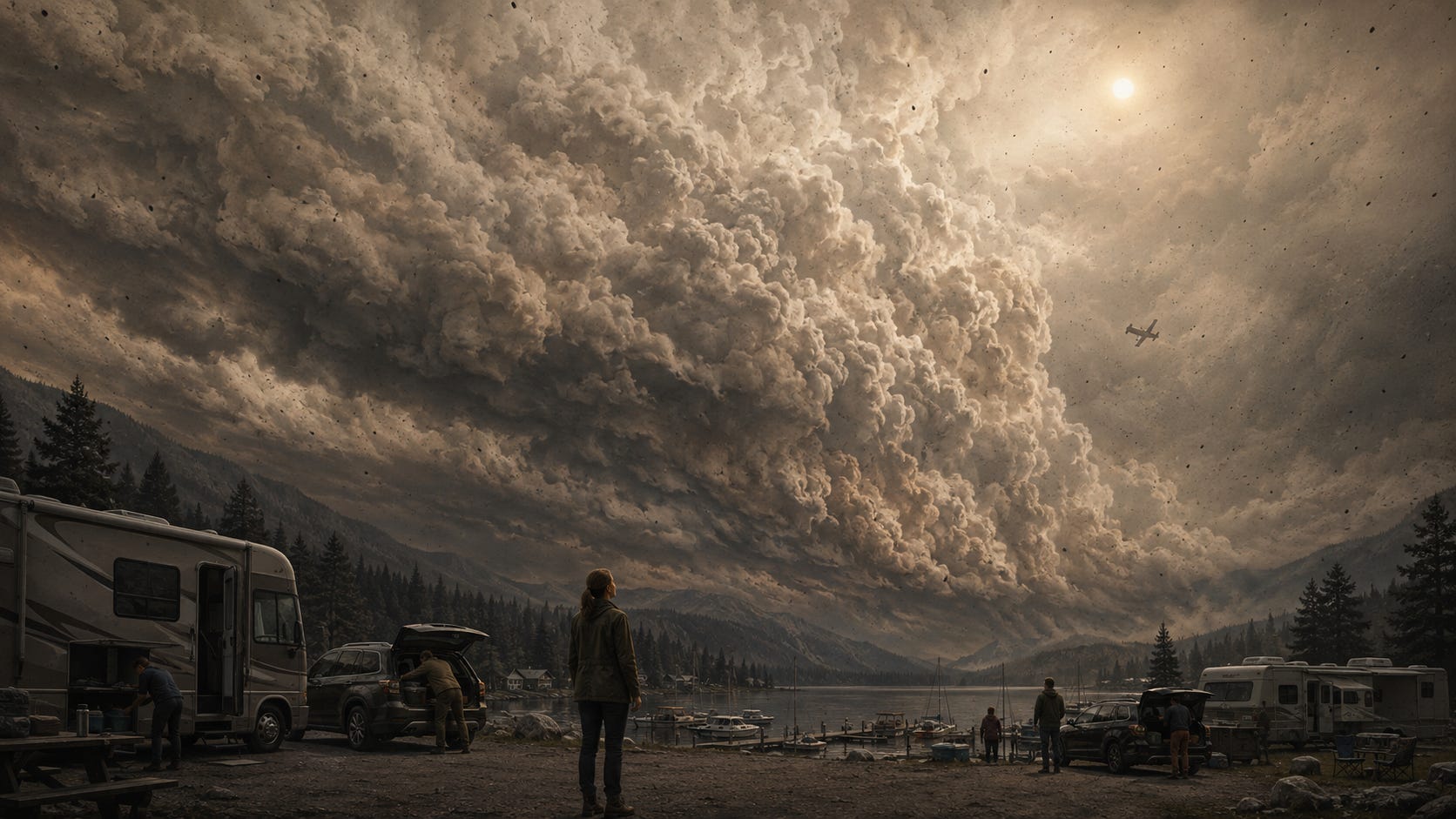
The pyrocumulonimbus was still there.
It had grown during the night.
Its base merged with the ridges to the southwest; its summit now occupied an entire section of sky. The cloud was no longer rising in a column. It had spread outward, folding in on itself, building into stacked masses whose edges caught a dirty white light.
No rain was falling.
Black dust traced tiny commas across the window. Diane ran a finger over the glass. A fleck of ash stuck to her skin.
She dressed without turning on the light.
• • •
By six, the coffee at reception was already too strong.
Diane let it run to the last drop anyway. She set three mugs beside the machine out of habit, then put one away. Noah never arrived before six thirty. Étienne appeared whenever he decided the day had begun.
She checked the official wildfire page.
The map had been updated at 4:12 a.m. The fire perimeter had grown slightly. The advisory level had not changed.
WILDFIRE BEING MONITORED. NO EVACUATION ORDER FOR THE ALDER LAKE AREA.
Diane read the sentence again.
Outside, wings beat over the roof. She looked up too quickly, as though a water bomber might already be flying in the half-light.
Only geese.
The door opened. Étienne came in carrying his boots.
“Did you know there’s a puddle outside your place?”
“It didn’t rain.”
“It’s not water.”
He set one boot on the counter. The sole was coated in gray mud, fine as wet cement.
Diane touched it with the tip of her finger.
“Ash and dew,” Étienne said. “It sticks to everything.”
He took a mug without asking.
“Did you sleep?”
“Yes.”
“How many minutes?”
Diane turned the screen toward him.
“The area isn’t under an evacuation order.”
Étienne read the advisory to the end.
“Updated at 4:12.”
“That’s recent.”
“That was before conditions started changing.”
“Nothing has changed here.”
Étienne looked out the window. The marina flags hung limp again.
“That’s exactly the problem. We don’t know what’s happening to us yet.”
Diane picked up her mug.
“Do you know something I don’t?”
“No.”
“Then we’re in the same position.”
“Not really. I know that I don’t know.”
She set her mug down a little too hard.
“And I have more than three hundred people I’m not going to move on a hunch.”
Étienne looked at the coffee spilled into the saucer.
“Preparing isn’t moving people.”
Diane said nothing.
Years earlier, during another alert, vehicles had left before the instructions were settled. An accident had followed. Diane had kept a rule simpler than the memory itself: you did not put people in motion until you knew where you were sending them.
Étienne knew the rule. He also knew Diane had never questioned it.
He did not push. He took a cloth, wiped the counter, and went back outside with his boots.
On the screen, the word MONITORED seemed larger than everything else.
• • •
Zoé Bell reached the marina at 7:23.
Curtis was waiting by the gate. He checked the water bottles, flashlights, and small first-aid kit without emptying their packs for a third time.
“Two liters each?”
“Yes, Dad.”
“Phones charged?”
Ana and Milo held theirs up.
Curtis noticed the orange whistle clipped to Zoé’s pack.
“Keep that where you can reach it.”
“Yesterday you said it was useless.”
“I’ve slept since then.”
Milo looked at the sky.
“Maybe we should postpone.”
Zoé turned toward him.
“Because of the cloud?”
“Because of the smoke.”
“The trail goes north. The fire’s southwest.”
Judith, sitting at a nearby table with her coffee and book, looked up.
“The fire is.”
Zoé waited.
Judith said nothing more.
Curtis checked his phone. One bar appeared, then vanished.
“Text me from the lookout. After that, send a picture from the bridge if you have service. If you don’t, turn around at noon. Service or no service.”
“You said before dinner.”
“I changed my mind.”
Zoé recognized the tone.
“Okay.”
Curtis leaned in to kiss her. She turned her head slightly, but not quite enough to avoid him.
The three teenagers took the trail behind the marina. Their packs appeared between the trees, then disappeared.
Curtis stayed by the gate.
“They have good boots.”
Judith opened her book again.
“So do a lot of people who get lost.”
Curtis looked at her.
“You could try silence once in a while.”
“I tried it in television. It wasn’t good for the job.”
• • •
The first water bomber arrived at 7:58.
This time, no one ran to the dock.
Campers stepped out of their trailers holding coffee mugs and watched the aircraft. It skimmed the center of the lake, farther out than the day before, then climbed heavily toward the valley.
Twelve minutes later, a second aircraft appeared. At 8:25, the first one came back.
By nine, Diane had stopped recording the passes. She no longer needed to count them to know they were coming closer together.
And still the campground carried on. A family inflated a giant pink flamingo on the beach. Owen washed the windshield of his RV with a long-handled squeegee. Noah opened the camp store, where bags of ice were selling twice as fast as usual.
Smoke had erased the blue from the sky without covering the sun. It hung there as a white disk, stripped of glare, easy to stare at.
Diane drove her electric cart past the campsites and stopped beside a woman already folding her chairs.
“You’re leaving?”
“My son has asthma. He’s been coughing since this morning.”
Diane looked at the boy sitting in the car, a cloth mask over his face.
“Need help hitching up?”
“My husband has it.”
“Take the north road to the junction. Don’t pull onto the shoulder, even to check the trailer.”
The woman nodded.
“You’re staying open?”
Diane looked around.
“For now.”
She disliked the answer as soon as she heard herself say it.
Near the community center, Étienne was loading water containers into the bed of his pickup.
“What are you doing?”
“Moving the reserve closer to the exit.”
“Why?”
“Because it’s behind the shed. Under the trees.”
“What if campers go looking for it?”
“Noah knows where it is.”
Diane stopped the cart.
“You’re preparing an evacuation without telling me.”
“I’m moving water.”
“You know exactly what you’re doing.”
Étienne put down a container.
“Yes. I’m buying ten minutes on a decision you haven’t made yet.”
“Put them back.”
He looked at her for a long moment.
“No.”
The word stayed between them.
Noah came out of the community center carrying a box of batteries, then slowed when he realized he had walked into the wrong moment.
Diane looked at the water, the truck, then her son.
“You don’t run this campground.”
“I know.”
“Then don’t make decisions for me.”
“I’m not deciding whether we leave. I’m deciding that the water will be accessible if you decide we do.”
Noah lowered his eyes to the box. Two campers by the bulletin board were watching them now.
“Finish it,” Diane said. “But nothing else without talking to me.”
Étienne nodded.
She drove away before he could see that she already regretted having proved him right.
• • •
At 9:40, Judith received a call on her satellite phone.
She walked to the far end of the dock. The voice at the other end was faint, broken by short silences.
“What time?... And the public bulletin?”
She turned toward the campground. Diane was crossing the lane in her cart. Étienne was securing the water containers. Curtis was setting up cameras on the beach.
“No. I’m not publishing anything. I just want to know what you actually know.”
She listened.
“A secondary cell where?”
The word vanished in static.
“Say that again.”
The connection dropped.
Judith called back.
Nothing.
When she folded down the antenna, Mara was standing behind her.
“Bad news?”
“Incomplete news.”
“That’s not the same thing.”
“It becomes the same thing when you have to make decisions with it.”
Mara looked toward their trailer. Gabriel sat beneath the awning, a blanket across his knees despite the heat.
“My father says the pressure is changing.”
Judith followed her gaze.
“Someone at the provincial center just told me there’s a secondary cell northeast of the fire.”
“Toward us?”
“I didn’t hear the rest.”
Mara looked at the smoke.
“Diane needs to know.”
Judith nodded.
“The official bulletin still says the north flank is stable.”
“Then one of them is wrong.”
“Or late.”
For the people at Alder Lake, the distinction was becoming thin.
• • •
Diane read Judith’s message in the reception office.
It filled four handwritten lines.
SECONDARY CELL REPORTED. NORTHEAST OF MAIN FRONT. CONFIRMATION INCOMPLETE. PUBLIC BULLETIN UNCHANGED.
“Who told you this?”
“A former colleague. She works at the provincial wildfire coordination center now.”
“Is she on the ground?”
“No.”
“Her source?”
“An emergency management team in the field.”
Diane set down the paper.
“Elaine Cho?”
“Her office, probably.”
“Probably.”
Judith folded her arms.
“Would you rather have uncertain information or no information?”
“I’d rather know where it comes from.”
“Do you know where the public bulletin comes from?”
Diane said nothing.
Étienne stood near the door. He had not been invited in, but no one asked him to leave.
“Call Elaine,” he said.
Diane dialed the regional emergency manager’s direct number. An assistant answered after five rings and put her on hold.
The same music as the day before filled the office.
Étienne walked to the window.
“It’s not the same cloud anymore.”
Diane covered the receiver.
“We don’t know that.”
“Look at it.”
“Looking isn’t measuring.”
“And measuring isn’t always understanding.”
Judith watched them both.
“Do you two have this conversation often?”
“For thirty-six years,” Étienne said.
The music stopped.
Elaine Cho came on the line. Her voice was calm and quick.
“Diane, we’re assessing unusual convective activity. Nothing justifies an evacuation of Alder Lake at this time.”
“Has a secondary cell been confirmed?”
“We have incomplete indications.”
“Where?”
“We’re not releasing a location until it’s validated.”
“Is it northeast of the fire?”
A brief silence.
“Keep monitoring official advisories.”
Diane kept her eyes on Judith’s note.
“Is the north road still the recommended route?”
“Yes.”
“For how long?”
“I can’t give you a time.”
“Then give me a condition.”
Elaine exhaled at the other end.
“If we see significant deterioration, you’ll receive an advisory.”
“Before the road is affected?”
“That’s the objective.”
It was not an answer.
Diane knew it.
So did Elaine.
“Thank you.”
She hung up.
Judith pointed at the note.
“So?”
“No evacuation order.”
Étienne turned around.
“That wasn’t the question. She didn’t tell you how long the road would stay safe.”
Diane folded Judith’s note in half.
“The north road is still open.”
“For now,” Judith said.
Diane slipped the note into her desk drawer.
“Yes. For now.”
• • •
Curtis’s shoot was supposed to begin at eleven.
Malik Desrosiers arrived before the first take with two cases of batteries and three drones packed into hard-shell cases. Étienne had warned him the day before; Malik had driven in that morning to decide for himself whether the evening show was still possible.
Curtis’s videographer was still looking for an angle that would hide most of the cloud behind the fir trees.
Malik was looking at the sky.
“I’m doing a test flight. After that, I’ll decide whether anything happens tonight.”
Curtis pointed toward his videographer.
“Can he film the launch?”
“As long as he doesn’t touch the controls.”
Owen waited by the ramp in a brand-new life jacket.
“Still selling freedom?”
Curtis was about to answer when one of Malik’s drones rose over the beach.
On the tablet, the campground appeared from above: rows of trailers, the marina, boats, children by the water. Then Malik rotated the drone toward the southwest.
The videographer stopped talking.
From the ground, the pyrocumulonimbus seemed to rise behind the ridge. From the air, they could see how far beyond it the cloud extended. A broad dark mass pushed northward; another bulge was forming east of the main plume.
Curtis spread two fingers across the screen.
“What’s that?”
“I don’t know. And I’d rather not guess.”
The light changed abruptly. The white disk of the sun disappeared behind a layer of smoke, and the campground on the screen turned brown.
Curtis searched the image for the trail. The forest was a continuous mass. Here and there, the old road appeared like a pale scar between the trees, then vanished.
“Can you follow that?”
Malik checked the flight data.
“Not on this battery. And not under that layer if the wind keeps coming up.”
Curtis checked his phone.
No message from Zoé.
It was 11:16.
“She was supposed to text from the lookout.”
“Maybe she lost service,” his videographer said.
Curtis looked back at the cloud.
“Yeah.”
This time, he was no longer thinking about the shot.
• • •
At 11:30, the first campers came to reception asking whether they should leave.
Diane gave each of them the same answer: no evacuation had been ordered, the north road remained open, and anyone who wanted to cut their stay short could leave calmly.
By the fifth person, the words had begun to lose their meaning.
“What does calmly mean?” a man asked. “Everybody’s hitching up at once.”
Through the window, Diane saw two trailers already blocking the main lane. A boat was backing up and failing to make the turn. A child was crying because his bicycle had been put away too soon.
Noah ran inside.
“Sector C wants to know if they should assemble. Somebody said an evacuation is being prepared.”
Diane looked at Étienne, who had just come in behind him.
“It wasn’t me,” he said.
“I didn’t say it was.”
“You thought it loud enough.”
Noah stood between them.
“What do I tell them?”
Diane took a blank sheet of paper.
“That the campground is still open, that we’re monitoring the situation, that they should keep their vehicles accessible and keep the lane clear.”
Étienne planted both hands on the counter.
“And tell them to prepare their medication, identification, and water.”
“That will start a panic.”
“No. It’ll keep them from looking for their passports while the fire is coming.”
“We don’t have an order.”
“We have ash in the gutters.”
Noah looked from one to the other.
“I can tell them to pack a bag without saying evacuation.”
Diane breathed in slowly.
“All right. One essentials bag per family. Nothing more.”
“And vulnerable campers?” Étienne asked.
“Mara’s making a list.”
He looked surprised.
“You asked her?”
“Twenty minutes ago.”
A quick smile crossed his face.
“What?”
“Nothing.”
“Say it.”
“You’re preparing without moving people.”
Diane handed him the sheet.
“Go help Noah.”
• • •
At noon, there was still no word from Zoé.
Curtis tried calling. The phone rang once, then went to voicemail. He called Milo, then Ana.
Nothing.
Judith, sitting near the marina, checked her watch.
“You told them to turn around at noon.”
“They may already be on their way back.”
“Maybe.”
Curtis walked a few steps, came back, then stared at the trail. It disappeared behind the trees less than fifty meters away. Beyond that lay only forest, slopes, and an old network of tracks poorly represented on the campground maps.
Malik returned from reception carrying a charged battery.
“How far can you go?” Curtis asked.
“First ridge. Maybe the lookout if the wind leaves me enough margin to get back.”
“Do it.”
Malik did not move.
“Does Diane know?”
Two minutes later, Curtis was talking to her over the radio.
“Still nothing. Malik can run reconnaissance toward the lookout.”
Silence.
“No unnecessary risk to the aircraft,” Diane answered. “And report immediately if you see anything.”
Malik took the radio.
“Copy.”
Curtis reached for the controller, then stopped before touching it.
“You fly.”
Malik nodded.
The drone rose between the trees.
For the first time that morning, Curtis’s fear had stopped belonging only to him.
• • •
At 1:10, a gust came down off the mountain.
There was no warning.
The trees bent toward the lake. Dead branches struck the roofs. A tarp tore loose from a trailer and sailed across the lane like a huge blue bird. The reconnaissance drone, which Malik had just relaunched, was shoved several meters sideways before he brought it back under control.
Then the wind died.
The silence afterward was worse than the noise.
Gabriel stood beneath his awning. Mara went straight to him.
“Sit down.”
“Listen.”
“To what?”
He was staring at the forest.
“Nothing.”
The birds were gone. Even the insects seemed to have fallen silent.
A piece of ash larger than a coin landed on the table.
It was still warm.
Gabriel crushed it with the tip of his cane.
“This isn’t just wind coming from the fire anymore.”
Mara looked up at the cloud. Its base had turned almost violet.
“Then what is it?”
Gabriel waited before answering.
“The fire is starting to make the wind.”
• • •
At two, the official bulletin finally changed.
EVACUATION ALERT FOR THE ALDER LAKE AREA. NO IMMEDIATE DEPARTURE REQUIRED. BE PREPARED TO LEAVE IF CONDITIONS CHANGE.
The message appeared on the phones that still had service, then on the reception screen. Noah printed twenty copies.
Diane read every word.
Be prepared.
Not leave.
Not stay.
Be prepared.
She picked up the campground PA microphone. Her voice came through the speakers with a slight echo.
“This is Diane Vautrin. The Alder Lake area is now under an evacuation alert. This is not an evacuation order. I repeat: this is not an evacuation order. Each family should prepare one essentials bag, keep your keys with you, and keep the main lane clear. Noah and the staff will be checking each sector. Anyone who needs assistance should report to the community center.”
Doors opened across the campground.
Outside, Étienne stood among the campers.
“Do not take the road without checking conditions with reception first. We’ll pass on any new information as soon as it’s confirmed.”
Diane released the button.
For one second, no one moved.
Then the entire campground came alive.
Storage compartments opened. Awnings folded in. Coolers were emptied, then packed again. People who had been laughing ten minutes earlier now spoke in low voices.
Diane set down the microphone.
“There,” Étienne said behind her.
“There what?”
“The moment they start getting scared.”
The campers kept preparing.
“No. The moment they start getting ready.”
She wanted to believe the difference would hold.
• • •
At three, Curtis walked into reception without knocking.
“Still nothing.”
Since noon, Diane had known the message from the lookout should already have come.
Now the clock was only confirming it.
“Then we move to an organized search.”
She unrolled the local map across the counter.
“Planned route?”
Curtis pointed to the lookout, then the old road and the lakeside trail.
“They were supposed to turn around no later than noon.”
Étienne traced the route with one finger.
“Eight kilometers here with no service. More if they kept going toward the bridge.”
Judith set her satellite phone beside the map.
“Three people left together. No indication they split up.”
Curtis opened his mouth, then closed it.
This time he understood why she was counting.
Malik came in behind him.
“The wind still won’t let me clear the first ridge. I may get another window if the layer lifts.”
“Get ready for it,” Diane said.
She assigned the roles.
“Malik searches from the air. Judith keeps the satellite line open. Noah checks the campsites, the messages, anyone who might have spoken to the kids before they left. Curtis, I need clothing, shoes, packs—anything we can identify from above.”
Curtis turned to Étienne.
“And you?”
“I’m not going in on foot until we know where they are. We could lose someone else in the smoke.”
Curtis stiffened.
“That’s my daughter.”
“Exactly,” Diane said.
He looked down at the map.
“And if we don’t find them?”
Diane checked the clock.
“Then we decide with what we know when we get there.”
Étienne looked up at her.
She had just used his principle without asking permission.
Diane folded part of the map back to expose the northern sector.
“For now, we search.”
• • •
Shortly after 3:30, Judith received another fragment of information.
She set her satellite phone down on the map.
“The secondary cell is moving east. They still can’t confirm that it’s affecting the north road, but they’re reassessing the junction.”
Diane traced the road with one finger.
“If it closes?”
No one answered immediately.
Gabriel, sitting near the window, pointed to a faded line on the map.
“There’s still this.”
Diane recognized the old forestry road.
Étienne shook his head.
“No.”
“You know that route.”
“I know why it was closed.”
Even Curtis went quiet.
Étienne kept his eyes on the map.
“Eight years ago, a storm damaged a distribution line in that sector. The main road was blocked. I recommended the old road to get a maintenance truck through.”
“It was already closed?” Diane asked.
“Not on the maps we were using.”
Gabriel did not correct him.
Étienne continued.
“At the old bridge, a rear wheel broke through a weakened section. The truck tipped into the guardrail. The driver broke his pelvis. An apprentice was thrown against the cab. They survived.”
Diane did not move.
“And you?”
“I signed off on the route.”
After the investigation, the road had been permanently closed. Étienne had sworn never to send a convoy down it again.
“Why didn’t you ever tell me?”
Étienne finally looked at her.
“Because every time I came back here, you were already reminding me of all the reasons I never stayed.”
Diane took the words without defending herself.
Gabriel rested one hand on the edge of the map.
“The road still exists. That doesn’t mean it’s usable.”
“And the bridge?” Diane asked.
“It was never reinspected for public traffic.”
Diane slowly folded the map.
“Then it isn’t a road.”
Étienne looked toward the sky.
“Not without an inspection.”
Judith’s satellite phone vibrated again.
Everyone turned.
• • •
At 4:20, Malik finally managed to push a drone as far as the first ridge.
Curtis, Diane, and Étienne crowded around the screen on the beach. Judith kept her satellite phone open, waiting for a connection.
The image shook.
Forest appeared in patches between curtains of smoke. The old road was barely visible, narrow and choked with weeds. Farther on, the lookout emerged at the edge of a rocky slope.
Empty.
Curtis leaned toward the screen.
“Lower.”
“I’m losing my return margin.”
“Just a little more.”
A gust spun the drone sideways. The image flipped from sky to forest, then back to sky.
“Bring it up,” Étienne said.
Malik corrected the flight path. The drone climbed.
For a second, the camera swept across the valley to the east.
Something glowed behind a ridge.
Not the main fire.
A short, sharp line of orange flame showed between the trees, exactly where the north road dropped toward the junction.
Malik froze the image.
No one spoke.
Judith slowly lowered the satellite phone from her ear.
“Confirmed. A secondary fire has started to the east.”
Diane put one finger on the map.
“How close to the road?”
“They don’t know yet.”
Curtis pointed to the old road on the screen.
“Zoé is somewhere out there.”
The secondary fire was on the same side of the valley as the north road.
On the map back at reception, the other way out still carried the scar of an accident eight years old.
Diane’s phone vibrated.
An emergency message appeared.
IN THE EVENT OF EVACUATION, LEAVE THE AREA VIA THE NORTH ROAD.
To the east, behind the trees, a second column of smoke was beginning to rise.
• • •
END OF EPISODE 2
Next: Episode 3 — All Roads Lead Back to the Fire