

Lire ORAGE DE FEU en français →
The first rumble did not come from the sky.
It came off the lake.
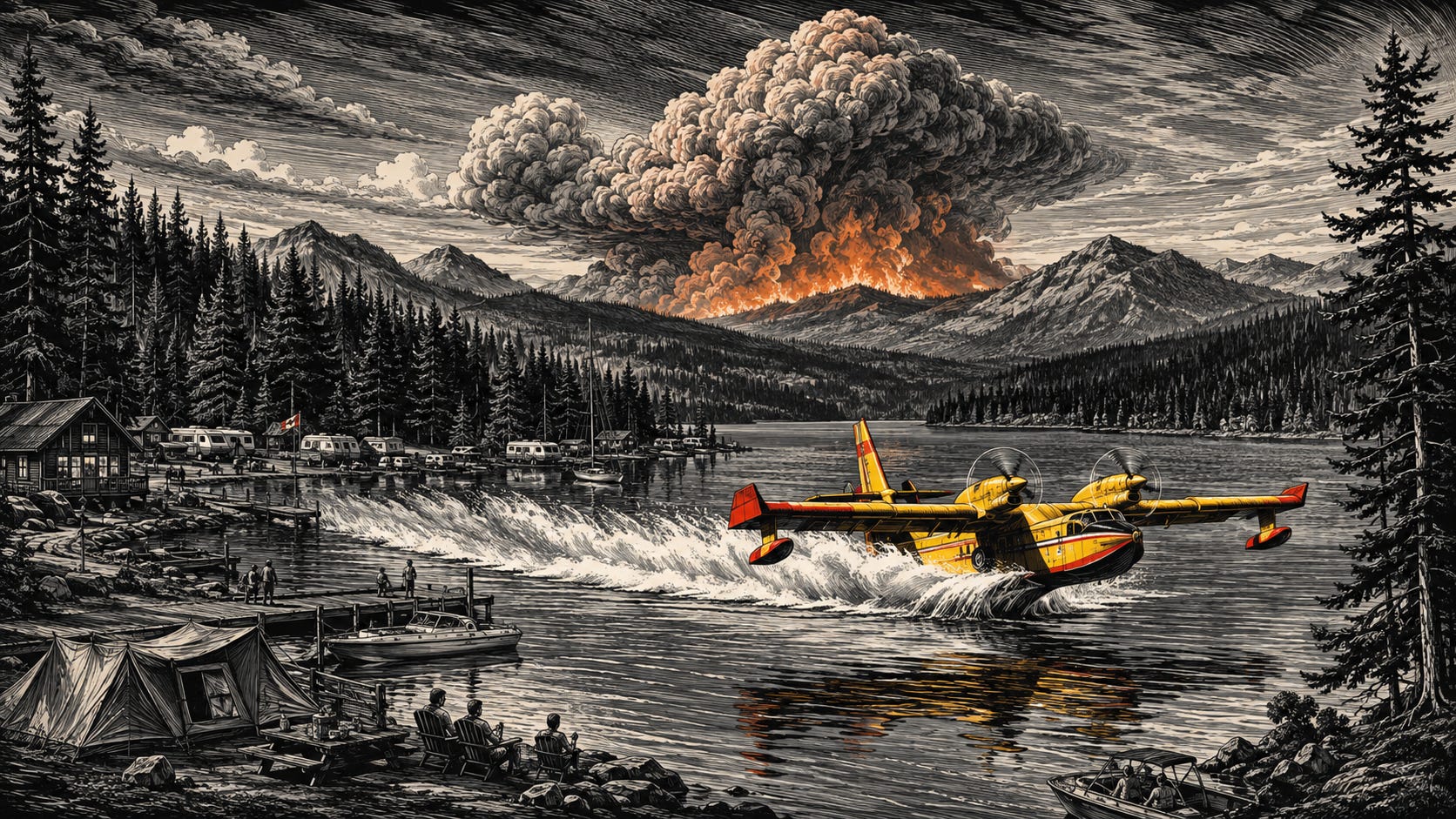
The Canadair water bomber burst from behind the wooded point, flying so low that several campers instinctively ducked their heads before cheering. The aircraft skimmed Alder Lake, scooped water in a long plume of spray, then climbed away, leaving two silver wakes behind it.
On the beach, phones went up at once.
— Look at that! It’s coming back!
Children were already running toward the dock. Regulars explained to newcomers how the plane would shave the surface before turning back toward the mountains. One father hoisted his son onto his shoulders. Two teenage girls abandoned their paddleboards to film. Near the marina, Curtis Bell, a recreational vehicle and equipment dealer, raised both arms and conducted the Canadair’s pass like an orchestra.
To them, it was the first show of the Labour Day long weekend.
To Diane Vautrin, it was already something else.
She slowly closed the arrivals register.
Far to the southwest, beyond the firs that sealed off the valley, a grey-brown column was rising with a steadiness she did not like. At its base, it still blended into the ridge. Higher up, it widened into a cloudless sky.
The Canadair came around again.
No one was watching the smoke. Everyone was watching the plane.
Diane put her smile back on.
— Welcome to Alder Lake Campground.
The couple in front of her handed over their reservation.
— You’re full? the man asked.
— Since last night. Site twenty-seven. Marina’s on the left, trails start behind the washroom building. Keep your food in the lockers, not under the awning. And don’t leave anything burning unattended.
— Not even marshmallows? the woman asked.
Diane hesitated for a fraction of a second.
— Especially not marshmallows.
They laughed and headed back toward their trailer.
A boy shot across the lane on a scooter. Diane called him back without raising her voice.
— Helmet, Leo.
The boy braked, retraced his path and grabbed the helmet hanging from the handlebars. His mother waved to Diane from site forty-two.
Diane knew the regulars, their habits and their small disasters. The ones who arrived every year on the Friday before Labour Day. The ones who always forgot an extension cord. The ones who set out their chairs before they had even levelled the trailer. The ones who needed help and would never ask for it.
The column kept rising.
A white pickup stopped in front of the office.
Étienne got out with a tool bag in one hand. He had let his beard grow since his last visit. Diane noticed, as she noticed everything, but said nothing.
He followed her gaze.
— Still watching the fire?
— Mostly watching the wind.
Étienne studied the flags above the marina. They hung almost straight down.
— There isn’t any.
— Exactly.
The Canadair returned, its roar swallowing the rest. Étienne waited until the aircraft climbed back toward the ridge.
— Morning, Mom.
Diane briefly rested a hand on his arm.
— You’re late.
— Good to see you too.
He smiled. She did too, despite herself.
A shout came from the boat launch. A man had dropped the jockey wheel on his trailer. Étienne set down his bag.
— Coming.
— You just got here.
— That’s what I said.
He crossed the lane before she could answer.
Diane watched him crouch beside the trailer, slide a chock beneath the axle, then show the owner how to free the wheel without bending the tongue.
He had always been like that: more comfortable with an open problem than a closed conversation.
Beyond him, the smoke kept growing.
• • •
By noon, the campground had recovered its usual noise.
Car doors. Coolers. Bicycle pumps. Children running from one site to the next. An old rock song playing from a radio beneath an awning. At the marina, Curtis was lining up three personal watercraft in front of a banner bearing the name of his dealership.
Owen Kessler, in a white shirt and dark sunglasses, leaned against his enormous motorhome as though posing for a catalogue.
— What am I supposed to say? Owen asked.
— Nothing. You’re living the dream.
— Can I live the dream while opening a beer?
— After the boat shot.
A girl with her hair tied in a ponytail walked behind them carrying a backpack. Curtis spotted her on the monitor.
— Zoé! Out of the shot!
She took two steps back, then crossed behind Owen again, waving both arms.
— Zoé.
— I’m not in the shot anymore.
— Where are you going with that?
Ana and Milo were waiting near the trail, one with a water bottle clipped at her waist, the other with a camera around his neck.
— Getting ready for tomorrow.
— Tomorrow what?
— The old bridge.
Curtis lowered his sunglasses.
— What old bridge?
A dry voice answered behind him.
— The one that’s been closed long enough for teenagers to find it interesting.
Judith Pike had stopped in the shade of a poplar. A retired television journalist, she held an enamel mug in one hand and a book in the other. At seventy, she still looked at people as though they had just made a statement she intended to fact-check.
Zoé rolled her eyes.
— We’re not driving a truck across it.
— That is exactly the kind of sentence people say before they need a truck, Judith said.
Curtis looked at his daughter.
— When are you back?
— Before dinner.
— Phones charged? You stay together? You text me from the lookout?
— Yes, yes and yes.
Judith set her mug on the nearest picnic table.
— Past the lookout, there’s almost no cell service.
Curtis shrugged.
— It’s Friday. They’re going for a hike, not crossing Antarctica.
Zoé kissed her father quickly on the cheek.
— We leave tomorrow morning.
— Seven-thirty at the marina.
— Why?
— Because I’m your father.
— Scientific argument.
Judith picked up her mug.
— Not very scientific, but rarely negotiable.
Zoé led Ana and Milo back toward the campsites. Curtis turned to his camera.
— Let’s go again.
A few metres away, Diane watched the teenagers until they disappeared behind the trailers.
Then she looked up at the column.
It had thickened.
• • •
At two o’clock, Diane removed the box of matches from the display at the office.
Noah Alvarez came in with two bags of ice over one shoulder. He dropped them into the freezer and read the notice Diane had just printed.
— “Immediate ban on all open fires.” Even raised fire pits?
— All of them.
— People bought firewood this morning.
— Refund them.
Noah contemplated the stack of dry wood against the back wall.
— That’s where our best margins are.
— They’ll burn better next year.
— What about the fireworks?
Diane looked out the window. On the beach, a child had just picked up a piece of bark so dry it crumbled between his fingers.
— Cancelled.
Noah whistled through his teeth.
— Now we’re looking at civil war.
— Put up the notices before they have time to form a government.
He left.
Diane called the regional wildfire service. A recorded voice asked her to hold. On the computer screen, the official map still showed the fire at a comfortable distance: northern flank contained, southern sector under observation.
Music that was far too calm played through the receiver.
Étienne walked in without knocking and set a broken hinge on the counter.
— The shed door’s still holding, but it’s not happy about it.
Diane covered the speaker with her palm.
— Fireworks are cancelled.
— Figured.
— Noah’s going to be eaten alive.
— We can replace them.
— With what?
— A drone show.
Diane stared at him.
— You keep one of those in your truck?
— No. Malik Desrosiers. He’s in Clearwater. Shows, aerial photography.
— And you know Malik Desrosiers.
— Mostly I know his phone number.
As if he had heard his name, Curtis backed into the office, absorbed by his phone screen.
— The light is perfect. Even with the smoke, it gives everything incredible depth.
He finally looked up.
— What are you smiling about?
— The part where you pay for it, Diane said.
Étienne explained: no pyrotechnics, a few simple formations over the lake. Malik could come the next day if he judged conditions acceptable.
Curtis put both hands on the counter.
— Can I film it?
— As long as nothing burns.
— My logo?
— No.
— A stylized personal watercraft?
— Curtis.
He raised his hands.
— Fine. I’m paying.
The hold music stopped. Diane picked up the receiver.
An operator confirmed that the wildfire remained under observation. No special order for the Alder Lake sector. Maintain normal precautions. Watch for updates.
— Normal, Diane repeated.
— Sorry?
— Nothing. Thank you.
She hung up.
Étienne was looking at the column through the window.
— What did they say?
— Nothing new.
— The column did.
• • •
By late afternoon, red notices had appeared on bulletin boards, washroom buildings and near the water taps.
OPEN-FIRE BAN
Noah stapled them up while campers read over his shoulder.
— Even in the fire pits?
— Even in the fire pits.
— We paid for wood.
— Diane will refund you.
— What about the marshmallows?
Noah pointed toward the community building.
— Seven o’clock. Giant campfire.
A boy frowned.
— A fake fire?
— High-definition fire.
— Is it hot?
— If you sit close enough to the projector.
The boy burst out laughing.
Noah continued his rounds. He knew which child was allergic to peanuts, which couple always argued while setting up the awning, which camper refused to read a sign before asking what it said.
Near the dock, Mara Singh was helping her father, Gabriel, down a gravel slope. He moved slowly with a cane, his legs stiff; a pale scar disappeared beneath the hem of his shorts.
— We should’ve taken the other way, Mara said.
— The other way is for tourists.
— We are tourists.
— Speak for yourself.
He stopped in front of the notice.
— No fires.
Mara followed his gaze toward the column.
— You know this area?
— Well enough not to like what I’m seeing.
Judith joined them, a small grey device in one hand.
— What are you seeing?
Gabriel pointed toward the ridges.
— The column’s going up too straight. The air is pulling upward.
Mara looked at Judith’s device.
— Satellite phone?
— An old journalist’s habit.
— Does it work out here?
— Better than cellphones when the sky is clear.
Gabriel gave a humourless laugh.
— It won’t stay clear for long.
Judith opened the antenna.
— According to whom?
— My legs.
Mara gave him a look.
— Dad.
— They’ve known enough fire to get suspicious before I do.
Judith looked toward the old road disappearing behind the trees.
— And that area?
Gabriel followed her gaze.
— Old maps can inspire too much confidence.
— The old bridge?
He planted his cane in the gravel.
— I wouldn’t treat it as a road.
Mara put a hand on his elbow.
— We came here to rest.
— Then stop asking questions.
A message appeared on Judith’s phone. She read it twice before slowly folding the antenna back down.
— What does it say? Mara asked.
Judith slipped the device into her pocket.
— That the fire is still under observation.
Gabriel looked at her.
— That’s not what you just read.
Judith held his gaze.
— Not exactly.
• • •
The wind shifted at about five-forty.
At first it was only a shiver across the surface of the lake. Boat wakes changed angle. The flags at the marina suddenly filled toward the north. A poorly secured patio umbrella rolled three metres before a camper caught it.
Then the smell arrived.
Not campfire smoke. Something drier, more bitter, working its way between the trailers and settling at the back of the throat.
Conversations on the beach slowed.
Curtis looked up at his banner.
— That ruins the sound.
His videographer stopped recording.
— The wind’ll die down.
— You a meteorologist now?
Owen patted the side of his motorhome.
— One good rain and this is over.
Judith, sitting at her table, barely looked up.
— There’s no rain in the forecast.
— Clouds make rain, Owen said.
— Not all of them.
Mara closed the windows of her trailer. Her father stayed outside, cane planted in the gravel.
Noah was chasing towels ripped from clotheslines.
Étienne climbed onto the shed roof to check an antenna. From up there, he saw the whole column for the first time.
It was no longer smooth. Its summit was spreading in layers, dirty white above, almost black at the base. The mass had begun to eat the blue out of the sky.
Diane called up from below.
— What do you see?
— Too much.
— Useless answer.
— Then don’t ask such a big question.
He climbed down the ladder. Diane was waiting with her arms crossed.
— The regional service is keeping the alert level where it is.
— I didn’t say anything about the alert level.
— What do you want me to do? Empty eighty-four sites because you don’t like a cloud?
— I want you to prepare people before you need to move them.
— Prepare them for what?
Étienne pointed at the sky.
— What we don’t know yet.
Diane pressed her lips together.
— We don’t panic three hundred people on a hunch.
— We don’t protect them with a formula either.
The wind dropped a handful of ash onto the metal roof of the office. It crackled like dry rain.
Diane picked one flake from her sleeve. It collapsed between her fingers.
— Not yet.
Étienne looked at the black smear on her skin.
— That’s always what you say before you decide too late.
She lifted her head.
— And you always decide before you know who’s going to pay for it.
He fell silent.
The words had found their mark.
Above them, the cloud mass kept swelling.
• • •
At seven o’clock, Noah had turned the community area into an improvised theatre.
The giant screen filled an entire wall. A campfire played on a loop, burning without heat: red flames, perfect logs, sparks rising into a night that did not exist around them. Families had settled in with blankets. Children held marshmallow skewers over an electric heater.
— Tastes the same, Noah announced into the microphone.
— Liar! someone shouted.
— It’s the spirit that counts!
Laughter rolled all the way to the beach.
Diane watched the crowd from the back. No campfires. No fireworks. And yet people had gathered.
Étienne came to stand beside her.
— See? You can replace things.
— A screen doesn’t replace a fire.
— No. It gives people a reason to come out of their own corners.
Curtis arrived with his videographer.
— Malik’s confirmed for tomorrow night.
— Has he seen the conditions? Diane asked.
— Says he’ll evaluate them when he gets here.
Étienne nodded.
— That’s what he should do.
Farther away, Zoé, Ana and Milo were comparing flashlights and water bottles for the next day. Curtis spotted them.
— Seven-thirty at the marina.
Zoé lifted a hand without turning around.
Judith approached her.
— A locator beacon?
— My phone.
— That’s not a locator beacon.
She took a small orange whistle from her pocket.
— Three blasts if you get lost.
Zoé took it.
— And who’s going to hear it?
— Someone looking for you.
Zoé clipped the whistle to her pack. Curtis looked away.
Diane missed none of it.
On the giant screen, the flames kept dancing without heat.
Behind the wall, the real sky was darkening.
• • •
The improvised show ended after nine.
Families returned to their sites. Children protested, then fell asleep before their parents had even zipped the screens shut. One last personal watercraft was hauled onto its trailer. Lanterns came on beneath the awnings.
Above the lake, the cloud now hid part of the stars.
Diane walked down to the marina. The surface was almost black; a few lights trembled on the water. Far away, the base of the column glowed now and then, not like a visible flame, but like an ember buried behind layers of smoke.
Étienne joined her carrying two coffees.
— You didn’t ask if I wanted one, Diane said.
— You would’ve said no.
She took the cup anyway.
They stood side by side.
— You’re leaving Tuesday?
— That was the plan.
— Plans change a lot with you.
— With everyone.
— Not in the same way.
He took a sip.
— Are we talking about work, or something else?
— We never talk about anything else.
A radio crackled inside the marina office. Curtis had forgotten to turn it off. A voice mentioned the rapid growth of the convective column above the wildfire. The next term vanished in static.
Diane stepped closer.
— What did she say?
Étienne turned the knob. The voice returned, clearer.
— ...possible formation of a pyrocumulonimbus, a thunderstorm cloud generated and fuelled by the intense heat and convection of a wildfire, with smoke and water vapour from the fire contributing to its formation. Residents in the area should continue to monitor official updates...
Curtis appeared in the doorway, barefoot.
— A pyro-what?
— Pyrocumulonimbus, Étienne repeated. A thunderstorm the fire is making for itself.
Curtis looked at the black mass.
— Does it make rain?
— Sometimes.
— Good.
— Not necessarily where you need it.
The radio crackled again.
Diane tightened her grip on the cup.
— The authorities haven’t changed the alert.
Étienne looked at her.
— The cloud won’t wait for them to.
A very distant rumble crossed the valley.
Curtis smiled.
— There’s the rain.
Gabriel was making his way slowly up from the dock. He stopped dead.
— No.
Everyone turned toward him.
He raised his chin.
— Too dry.
The sky remained silent for several seconds.
Then white light twisted inside the smoke.
Not above it.
Inside it.
Lightning burst from the cloud like an inverted root reaching for the ground. It lit the ridges, the lake, the marina and the hundreds of roofs across the campground.
No one spoke.
The thunder arrived later, enormous and out of sync, rolling from one mountain to the next.
Diane looked at the column.
The last weekend of summer had just become something else.
• • •
END OF EPISODE 1
Next: Episode 2 — The Storm Without Rain