

PREVIOUSLY...
At Alder Lake Campground, the wildfire had made its own storm. The pyrocumulonimbus had shifted the wind, scattered ash, and made official information obsolete almost as soon as it was released.
On Saturday, Zoé Bell, Ana, and Milo had set out toward the old bridge and never returned. Diane Vautrin had launched a search with Malik Desrosiers and his drones. She had also learned that an old forestry road might offer another way out—and that Étienne had sworn never to send another convoy down it after an accident eight years earlier. At 4:20 p.m., a secondary fire had appeared near the north road. Seconds later, the emergency alert still named that same road as the evacuation route.
• • •
On Sunday morning, Alder Lake no longer reflected the sky.
Gray light lay across the water, too even to cast a shadow. The docks, the boats, and the wooded point looked cut from an old photograph.
Diane stepped out of reception carrying a mug she soon forgot to raise to her lips. The smoke column had disappeared behind something larger than itself.
You could no longer see the pyrocumulonimbus.
You lived beneath it.
Noah was finishing a sign beside the main water tap.
CONSERVE WATER — PRECAUTIONARY MEASURE
He stepped back to inspect his work.
“Does that say disaster or municipal government?”
“The way you hung it? Mostly yard sale.”
Noah straightened the sign.
“I’m aiming for professional without losing my audience.”
His smile faded when he looked at the sky.
“You sleep?”
“Enough.”
“So no.”
Diane handed him a stack of sheets.
“Go through the campsites. Check people who are alone, medication that needs refrigeration, and vehicles with more seats than passengers.”
Noah scanned the first page.
“Is this an evacuation?”
“It’s an inventory wearing running shoes. Don’t use any word that’s going to scare people.”
“I can be discreet. Yesterday I announced a high-definition campfire over the PA and nobody died of disappointment.”
He left with the sheets. At the first junction, he was already slowing to help a woman force shut the stubborn trunk of her car. He kept joking, but his pencil never stopped moving.
At the marina, Curtis had barely put down his phone since the day before. After Saturday’s last gusts, the smoke had thickened and Malik had been unable to get another drone into the air. Curtis had spent the night in the cabin, between the frozen image from the last reconnaissance flight and calls that no longer even reached a ring.
Zoé’s last message was still a photograph of the sign marking the old road. In one corner of the image, the orange whistle Judith had given her hung from her pack.
At two in the morning, Curtis had still been telling himself they might have found somewhere safe to wait.
By dawn, he had stopped telling himself anything.
He tried again.
Nothing.
Then he headed for reception.
Judith arrived at the same time, satellite phone in hand. She unfolded the antenna, waited for the device to acquire a signal, then held the screen out to Diane.
The message came from the same former colleague of Judith’s at the provincial wildfire coordination center.
EXTREME FIRE SPREAD. ERRATIC BEHAVIOUR. PREPARE VULNERABLE AREAS FOR PRECAUTIONARY EVACUATION.
Diane read the three lines twice.
“Why isn’t any of this in the public alerts?”
“Because it isn’t an instruction yet. It’s an internal assessment.”
“A hypothesis.”
Judith looked at her.
“A hypothesis based on observations we don’t have.”
Curtis came in.
“When do we put the drones back up?”
Diane checked the clock.
“As soon as Malik gives us a window.”
“We already lost the night.”
“We’re not losing a fourth person by sending someone blindly into the smoke.”
Curtis tightened his grip on the phone, but did not argue.
Étienne arrived a few minutes later with Gabriel Singh. The old man walked with his cane, refusing the arm Mara offered him. Diane placed Zoé’s photograph and the map they had been using since the day before on the counter.
“Reconnaissance stopped at the first ridge. We pick up there.”
Gabriel enlarged the image, then the section of trail visible behind the teenagers.
“They took the old alignment.”
“There’s more than one?” Curtis asked.
“There used to be. The newer maps only show one.”
Gabriel put a finger on the wall map and slid it past the printed boundary.
“If they followed the old markers, they went through Cedar Bend before reaching the bridge.”
“So?”
“So the bridge isn’t the first problem.”
Mara watched her father. He had slipped back into that calm voice that made no room for useless comfort.
“What comes before it?”
Gabriel looked at Étienne.
“Ground the maps don’t describe well. Some sections have shifted since the old fires.”
Diane looked at the map. The bridge was only one obstacle. Before they could know whether the teenagers had even reached it, they had to understand the terrain between here and there.
She assigned the roles.
“Malik on drones. Judith stays on satellite. Noah keeps counting people, vehicles, and supplies. Mara, get ready in case we bring back an injured person. Étienne, you and Gabriel guide Malik.”
Curtis looked up.
“And me?”
“You tell me everything you know about their route without adding what you hope.”
Curtis looked at Zoé’s photograph.
This time, he obeyed.
• • •
Malik had set his cases on a picnic table before Diane had finished assigning jobs. He sorted the batteries by charge level and compared the topographic map with the route sketched the day before.
“Twenty-eight minutes per battery. Less in this wind. I have six. I don’t fly over dense smoke, and I always keep a return route.”
Curtis pointed toward the forest.
“My daughter is somewhere in there.”
“Exactly. If I lose the aircraft on the first pass, it won’t find her on the second.”
Curtis clenched his jaw, then stepped back.
Étienne traced a corridor from the campground to Cedar Bend and the old bridge. Gabriel corrected the route twice.
“Here. The road slumped after the ninety-eight fire.”
“The map puts it farther north.”
“The map shows where it was before the river took the bank.”
Malik looked up.
“Am I following your memory or GPS?”
“Both,” Étienne said. “If they disagree, you come back.”
The first drone lifted with a soft buzz.
A few campers drifted closer, assuming it was part of the show planned for that evening. Noah moved them back with his friendliest smile.
“Technical rehearsal. Great art requires silence and a lot of distance.”
“Is there really going to be a show?” a child asked.
Noah glanced at the sky.
“Today we stick to whatever’s useful.”
While Malik guided the drone over the trees, Noah kept building his inventory: children, older campers, people with limited mobility, oxygen tanks, first-aid kits, electric coolers, empty seats in vehicles.
Mara turned the community hall into a makeshift medical station. She lined up water bottles, blankets, dressings, and emergency medication.
Owen set a case on one of the tables.
“You building a hospital?”
“No. I’m trying to keep us from needing one.”
“I’ve got a defibrillator in the RV.”
Mara looked up.
“Why?”
“The salesman said it was reassuring.”
“And you believed him?”
“I bought the massage seats too.”
Despite herself, Mara smiled.
“Bring both. We’ll decide which one saves more people.”
At reception, Judith took a satellite call. The voice was weak, broken by sharp bursts of static. She wrote down every sentence before hanging up.
“The north road is still open, but only to essential services. The secondary fire near the east junction is still advancing.”
Diane checked the map.
“The official message still says to be ready to leave by that road.”
“It’s twelve minutes old.”
“Twelve minutes isn’t old.”
“Today it is.”
Gabriel came closer. Fatigue had hardened his face.
“The wind should shift south late this afternoon. If it comes down from the cell the way they expect, it’ll push the smoke into the valley.”
Diane asked only one thing.
“Give me times.”
Judith checked her notes.
“First signs around 4:30. Critical window between six and eight. After eight, the old road could become unusable.”
Diane put both hands on the table.
For the first time, the danger had hours attached to it.
Malik called them outside.
The drone had reached Cedar Bend. On the screen, forest moved beneath it in dark green masses broken by patches of ash. An old fire truck appeared, half sunk into the ground, birch trees growing through the chassis.
Gabriel stared at it a second too long before looking away.
“Keep going.”
Malik moved the drone forward. Beyond the truck, the trail split. One branch disappeared beneath the trees; the other dropped toward the river.
“They could’ve taken either one,” Étienne said.
Curtis leaned toward the screen.
“Zoé always picks whichever one looks more like a bad idea.”
A spot of orange appeared near a tree trunk.
Judith leaned in too.
“Stop.”
Malik stabilized the image and zoomed.
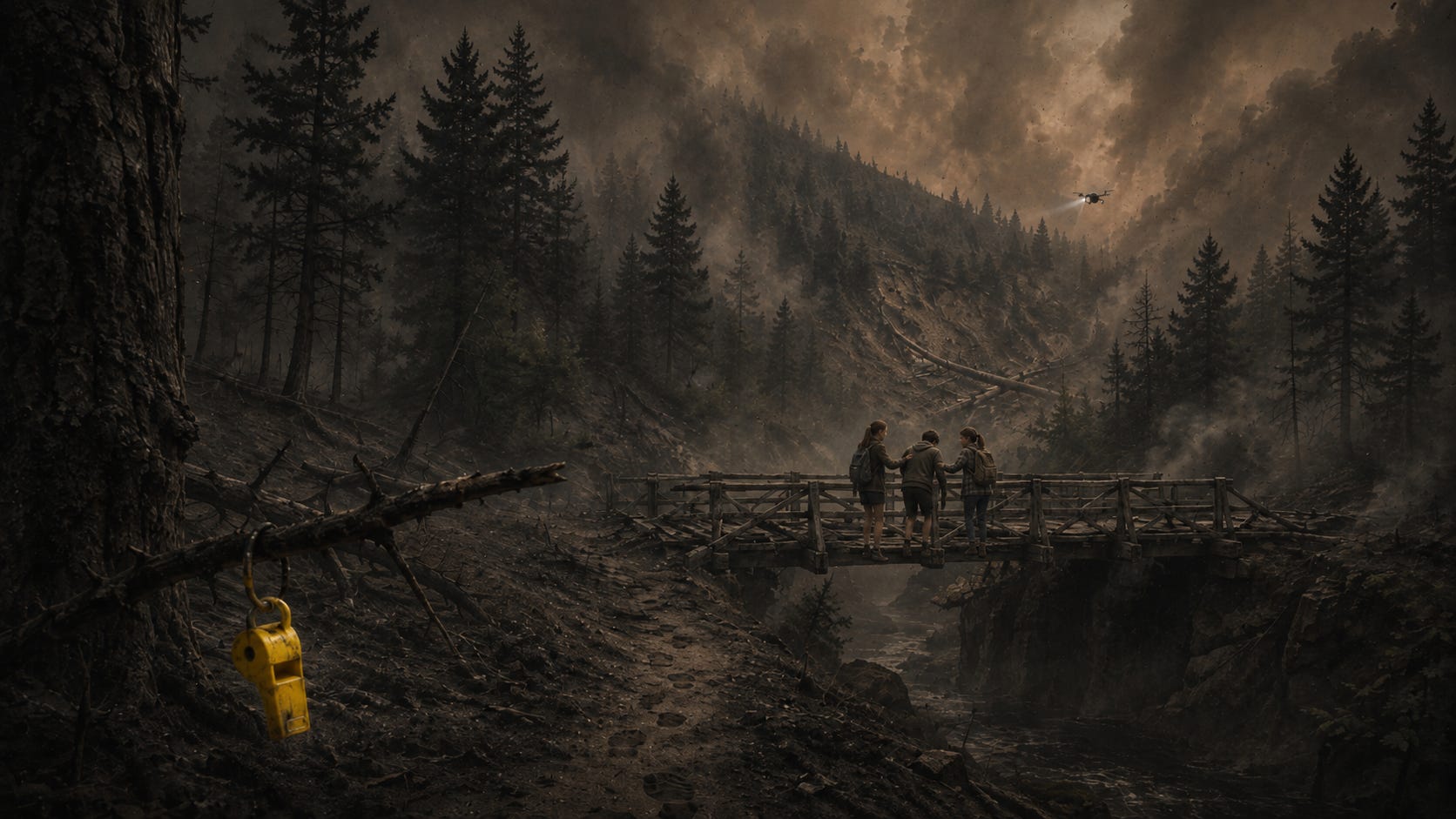
The orange whistle hung from a low branch.
Curtis went pale.
“That’s Zoé’s.”
Farther on, three sets of footprints marked the dust toward the old bridge.
“They’re together,” Judith said.
This time, Curtis did not mock the arithmetic.
The drone kept going until the smoke thickened. The old bridge appeared between the trees, gray and narrow above a river reduced to a dark thread.
At the entrance, one figure raised both arms.
Then a second.
Then a third.
Curtis gripped the edge of the table.
“Zoé.”
Malik brought the drone lower. All three teenagers were alive. Ana was supporting Milo, whose leg appeared injured. Zoé pointed toward the trail behind them, where a fresh collapse had cut off their return.
Étienne studied the image.
“They can’t go back the way they came.”
“Then we go get them across the bridge,” Curtis said.
Gabriel shook his head.
“Not until we inspect the approach.”
“My daughter is there.”
“And two other kids with her. If you turn one rescue into a second accident, you haven’t helped them.”
Curtis stepped forward, but Mara simply raised one hand in front of him.
“My father isn’t asking you to wait because he enjoys it.”
Gabriel never took his eyes off the screen.
“The old road can still reach them from the far side. But we have to inspect the bridge and the approach. Fast.”
Gabriel turned to Étienne.
“You know that access.”
“Yes.”
“And you know what it cost us before.”
Étienne held his gaze.
“Yes.”
The silence changed.
• • •
Judith came into reception with the satellite phone still open.
“The secondary fire is moving toward the official route. Elaine confirms the road is under assessment. She still refuses the old road without an inspection.”
“She’s right,” Étienne said.
Diane looked at him.
“And you’re going to inspect it anyway.”
“Yes.”
“Why?”
Étienne pointed toward the screen, where Zoé was helping Ana settle Milo against one of the old bridge beams.
“Because we’re not choosing between a good road and a bad one anymore. We’re choosing between the ones that are left.”
Malik launched a second drone fitted with a thermal camera and spotlight. Étienne left with Gabriel for the closed entrance to the road. Curtis tried to go with them; Diane kept him at reception to guide Zoé using the drone’s light signals.
Étienne opened his pickup and took out hydraulic cutters, a pry bar, and two cans of orange marking paint. Behind the seat, his work bag was still packed for Tuesday.
Diane saw it.
Étienne shut the door.
The old road began behind a metal barrier eaten by rust. A crooked sign still read NO ACCESS.
Étienne cut the chain.
The snap echoed through the forest.
Gabriel went first, slowly, watching every change in the texture of the ground. Étienne marked dangerous areas with orange paint. Above them, the drone tracked their progress.
“You don’t have anything to prove,” Gabriel said.
“I know.”
“Then don’t race what happened here.”
Étienne stopped at an almost invisible crack. He drove the pry bar into the ground, leaned his full weight on it, waited, then moved on.
“Last time, I was trying to save time.”
“And now?”
Étienne measured the width of the passage again.
“Now I want to know how much we have left.”
They reached a washout. The road had narrowed to a strip between the slope and open air. Étienne tested the surface and radioed the measurements back to Diane.
“The big vehicles won’t make it. Cars and pickups, one at a time. Nothing on the shoulder.”
“And Owen’s RV?”
Étienne studied the bend.
“Not in its current configuration.”
At reception, Owen heard him.
“What does ‘current configuration’ mean?”
Noah looked up from his list.
“Your rolling palace is going on a diet.”
Owen looked out the window toward his boat, the exterior storage compartments, and the bicycles mounted on the back.
“I paid for all of that.”
“The fire doesn’t ask for receipts.”
Owen did not laugh.
But he started unhooking the bicycles.
At the old bridge, Malik’s drone landed briefly beside the teenagers. Curtis’s voice came through its speaker.
“Zoé, it’s Dad. Don’t cross. We’re coming from the other side. Show me how many people are hurt.”
Zoé raised one finger and pointed to Milo. Then she made a circle with her arms over her head: they still had water.
Curtis closed his eyes for one second.
Diane picked up the radio.
“Étienne, condition of the bridge?”
He was now a few hundred meters from the structure. Smoke threaded between the trees in bands that were getting steadily thicker.
“Abutments are holding. Several deck boards need reinforcement. People and light vehicles can cross, one at a time. Not without prep.”
“How long?”
“With two of us, two hours to secure the minimum. Send me two people with lumber and the tools from the shed, and Gabriel and I can reinforce the critical sections, leave them the markings, and head back.”
Judith checked the time.
3:52 p.m.
Noah’s lists, Malik’s batteries, and contradictory messages covered the counter. Farther away, Mara was finishing the medical station. A brief memory came back to Diane: taillights leaving too early during another evacuation, then the accident she had turned into a rule.
Waiting no longer erased the risk.
It only decided which risk would arrive without her.
“Prepare the road. We’re not sending anyone down it yet, but from now on it’s our official fallback. I’m sending two staff with lumber and tools.”
Silence on the radio.
“Copy,” Étienne said.
That single word carried the weight of a door Diane knew would not close again.
• • •
At 4:29, the lake changed color.
The steel surface turned almost instantly dark brown, as if an immense shadow had crossed the ridge. The marina flags, hesitant until then, snapped north. A first gust lifted dust from the roads, flattened tablecloths across picnic tables, and cracked the awnings.
Gabriel had returned from the old bridge with the first measurements while Étienne stayed behind to supervise the reinforcement work. He checked his watch.
“It’s starting.”
Diane did not need to ask what.
A second gust came down from the mountain, colder than the surrounding air. It carried the smell of burned resin and wet earth, though no rain was falling. Pine needles spun over the campground.
Judith received a satellite call and switched to speaker. Elaine Cho, the regional emergency manager, came through clearly between bursts of static.
“The north road is closed at the east junction. We’re trying to open an evacuation corridor to the north, but I can’t guarantee it will be available.”
“How long?” Diane asked.
“I don’t have a time.”
“We inspected the old road. It’s passable under specific conditions.”
“It is officially closed and not authorized for a group evacuation.”
Diane let a second pass.
“After eight, it probably won’t be passable at all.”
Silence moved through the connection.
“Diane, if you put three hundred people on an uncertified bridge and it fails, no weather bulletin is going to protect you from that decision.”
Étienne was still on the old road, within radio range. Eight years earlier, he had signed off on the route that nearly killed two men. Today he was asking her to consider the same road—but only after inspecting it.
“I know.”
“Then wait for our corridor.”
The connection dropped.
Judith folded the antenna.
“She didn’t say the corridor was going to open.”
“She said they were trying.”
“That isn’t the same thing.”
Noah came in with the final count.
“Three hundred twelve people present or expected, including the three kids at the bridge. Eight need help walking. Two are on oxygen. We have fifty-nine vehicles that can leave, but seventeen trailers or boats will have to stay if we use the old road.”
Owen stood behind him.
“My vehicle can carry nine if I empty the storage compartments and unhitch the boat.”
Curtis looked at him.
“You’re leaving your boat?”
“It can’t drive itself.”
Noah smiled.
“There it is. The rolling palace discovers solidarity.”
“Don’t put it on a sign.”
Mara arrived with her medical bag.
“The station is ready. I can send a light team to bring Milo out as soon as the bridge is secure.”
Curtis shook his head.
“I’m going.”
“With her,” Diane said. “Not before.”
Malik warned that the drones would not stay airborne much longer. The gusts were becoming too erratic. In the last image they received, Zoé, Ana, and Milo had taken shelter beneath the bridge structure. Smoke was moving between the trees behind them.
Diane checked the wall clock.
5:12 p.m.
The critical window would begin at six. After eight, the old road would be considered unusable. No one could say exactly when the downdraft would reach the valley.
Diane picked up the PA microphone.
The conversations stopped before she even spoke. Three hundred nine people were already facing reception.
Three more were waiting at the old bridge.
“This is Diane Vautrin. We have not received a general evacuation order. The north road is closed, however, and we are preparing an alternate route. From this point on, return to your campsite and gather your medication, one bottle of water, warm clothing, and one piece of luggage per person. Trailers, boats, and nonessential equipment will remain here.”
A murmur moved through the campground.
“Noah and his team will assign you a vehicle and a departure order. Do not leave the grounds without instruction. Do not block any road. We will make our next decision as soon as we have the next reliable piece of information.”
She handed back the microphone.
Étienne had returned. The two employees were finishing the markings at the bridge and would pack the last tools before heading back.
“You just prepared an evacuation without Elaine’s authorization.”
“I just prepared people not to die in a traffic jam.”
“That isn’t what you would’ve said yesterday.”
The road remained invisible behind the trees.
“Yesterday I could still wait for someone to tell us which way to go.”
A gust struck the building. The windows shuddered. Above the valley, the pyrocumulonimbus spread through copper-colored light. Ash, heavier than the day before, settled on hair, hoods, and picnic tables.
5:26 p.m.
The satellite phone rang.
Judith answered, listened, then handed it to Diane.
Elaine was speaking faster now.
“The northern evacuation corridor will not open. I repeat: it will not open. The secondary fire has crossed the river. We recommend you shelter in place until further notice.”
Around her, the sky was lowering. Noah was organizing the vehicle assignments; Mara was packing her equipment; Owen was unhitching his boat; Curtis was staring at the frozen image of his daughter.
“Until what notice?”
Elaine did not answer immediately.
A low rumble moved through the cloud. The light dimmed again.
“Diane, do not take the old road.”
The connection died.
Étienne had heard.
Diane turned to him.
“If we go, how far can you get us?”
He looked at the open gate, the orange paint disappearing into the forest, and the bridge he had sworn never to use again.
“To the next decision. Then we decide again.”
Diane checked the time one last time.
5:31 p.m.
The window had not opened yet.
But every other one had just closed.
• • •
END OF EPISODE 3
Next: Episode 4 — The Sky Catches Fire