

PREVIOUSLY...
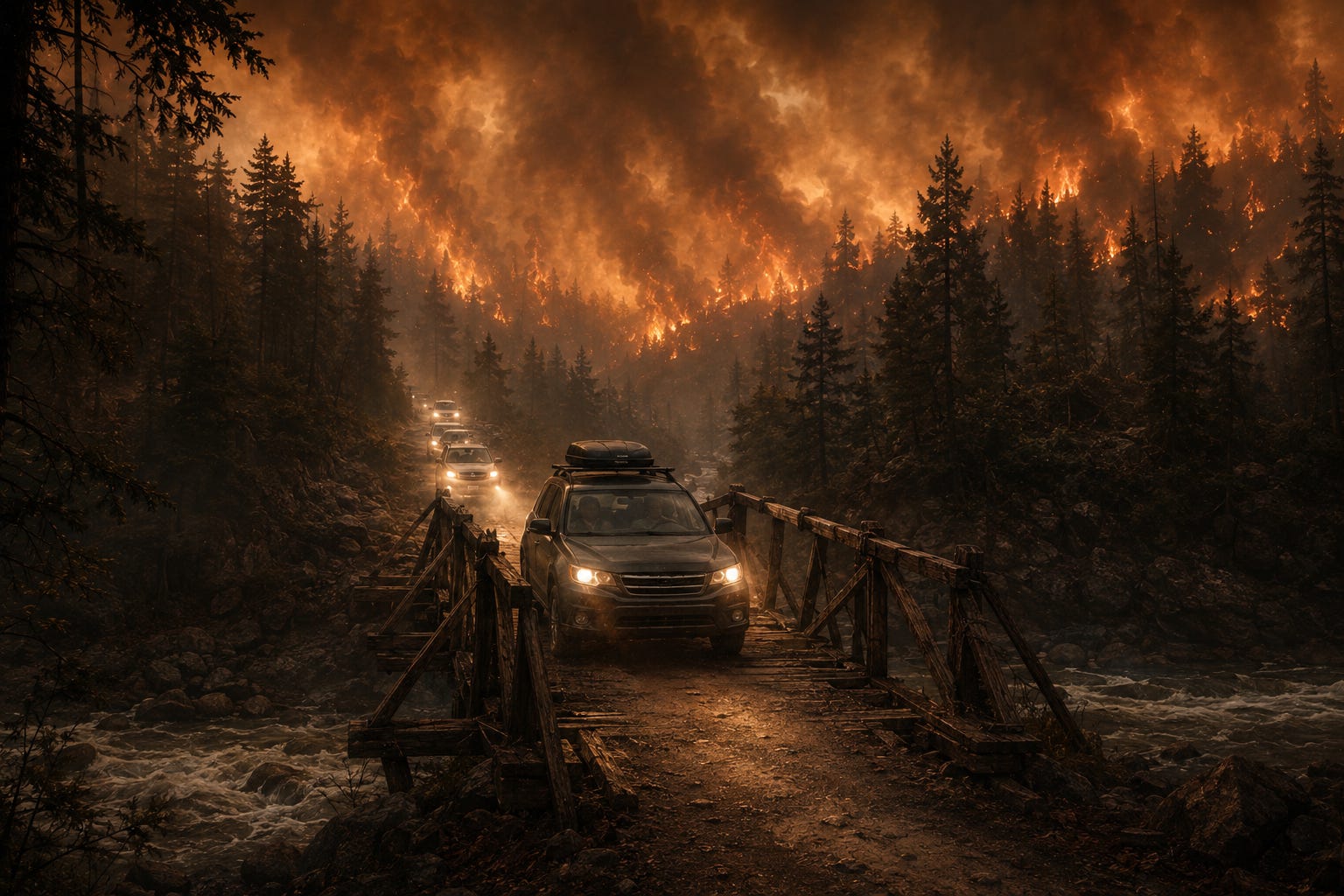
At Alder Lake Campground, the last big weekend of summer had turned when a wildfire made its own storm. A secondary fire had cut off the north road, while Zoé Bell, Ana, and Milo remained stranded near the old bridge. Diane Vautrin had spent too long waiting for an instruction that could guarantee everyone’s safety. There wasn’t one anymore. At 5:31 p.m., the evacuation corridor promised by the authorities had disappeared. All that remained was the old forestry road, closed for years, and less than two and a half hours before the wind made it unusable.
• • •
At 5:32 p.m., Diane picked up the microphone.
There was no more information to wait for.
In front of reception, three hundred nine people were already standing beside their vehicles, trunks open, awnings folded away. Children carried their bags without asking why. Above them, the ash was falling thicker now, light and black, catching in their hair like snow that refused to melt.
Étienne stayed beside her.
One minute earlier, she had asked how far he could get them.
To the next decision.
For the first time, that was enough.
Diane pressed the button.
“This is Diane Vautrin. We are evacuating the campground.”
The slight echo of her voice moved through the speakers.
No one screamed or ran. Someone closed a trunk.
A mother took her son by the hand; a man pulled the wheel chocks from his pickup. Near Sector C, two campers helped a neighbour move an oxygen cylinder into a vehicle already carrying three passengers.
Diane continued.
“We’ll be taking the old forestry road. It’s narrow, some sections are unstable, and we’ll have to move slowly. Follow the departure order Noah gives you. No passing. No turning around. Trailers, boats, and all nonessential equipment stay here.”
A murmur went through the crowd at the last words. Not protest. Only the very concrete sound of a world people had begun to leave behind.
“One piece of luggage per person. Medication, identification, water. If something makes you hesitate, leave it.”
She stopped.
The old arrivals ledger lay behind her on the reception counter, open to names, site numbers, reservations for the following weekend. For twenty-five years, Diane had organized her life around those boxes.
She looked up at the families gathered in front of her.
Today, the boxes were no longer what mattered.
“The campground can burn,” she said into the microphone.
She let a second pass.
“Not you.”
This time, the murmur died.
Diane handed the microphone to Noah.
“Deploy the plan.”
He nodded and looked down at the sheets already covered in marks.
“Sectors A and B in vehicles one through fifteen. Anyone who needs assistance stays at the community center until Mara places them. Nobody leaves until I’ve checked off their name.”
He turned to two staff members.
“You take the east lanes. I’ll do the marina and Sector C. If a seat opens up in a vehicle, tell me. If someone’s missing, don’t assume anything. You look.”
He used the same tone he might have used to announce a horseshoe tournament or find the owner of a lost dog.
This time, he wasn’t smiling.
Mara Singh had moved her medical station outside the community center. The ER nurse checked water bottles, medication, and the people whose limited mobility would slow the group.
“Mrs. Bergeron with the Kesslers,” she told Noah. “Mr. Ducharme in vehicle twelve. The two people on oxygen go in vehicles three and four. Not together.”
“Why separate them?”
“If one vehicle breaks down, we don’t lose both oxygen supplies in the same place.”
Noah wrote down the change.
“That’s why you make the lists and I make the jokes.”
“Today, do both. People listen better when they’re still breathing.”
Noah looked up, then moved on.
Near the marina, Owen Kessler stood in front of his boat.
He had already taken the bicycles off the RV. The outside storage compartments were open; clothes, folding chairs, cooking gear, and tools formed a small pile on the gravel.
Curtis Bell helped him remove the last strap from the trailer.
“You really going to leave it?”
Owen looked at the white hull.
“No.”
He unhitched the trailer.
“That’s why it matters.”
The boat stayed alone beside the launch ramp.
Owen turned immediately to the RV and opened the door.
“I’ve got nine belted seats. Who’s riding with me?”
Noah appeared almost at once with his list.
“You just got popular.”
“Enjoy it. It won’t last.”
Three elderly campers and a family of four were sent his way. Owen loaded their bags himself, leaving his own behind when the storage space filled up.
Diane saw it from reception.
The group was changing, not because the fear had eased, but because it finally had a direction.
• • •
Malik Desrosiers slid a fresh battery into the drone controller.
The main aircraft could not stay up much longer in the gusts, but it still held an intermittent link with the old bridge.
On the screen, Zoé, Ana, and Milo were still visible beneath the structure, tiny figures in the bands of smoke moving through the trees.
Curtis leaned over the pilot’s shoulder.
“Are they moving?”
“Zoé and Ana, yes. Milo, not much.”
Mara stepped closer.
“His leg?”
“I can’t see well enough.”
Malik brought the drone down a few meters. The image blurred, came back, trembled in a gust.
Zoé looked up.
The drone’s small spotlight blinked twice.
She answered by raising one arm.
Curtis closed his eyes for a fraction of a second.
“She knows we’re coming.”
“She knows we can see her,” Judith Pike corrected without looking away from her satellite phone. “Let’s not promise her the rest yet.”
Curtis turned toward her, ready to snap back, then swallowed the words. For three days, Judith had been asking the questions he did not want to hear. This time, he only looked at the screen.
The satellite phone vibrated.
Judith answered.
“Yes.”
She listened, wrote down two words, then looked up at Diane.
“Elaine.”
Diane took the phone.
Elaine Cho’s voice came through broken by static.
“Diane, we’re confirming the north evacuation corridor is completely closed. No emergency vehicle can reach Alder Lake by the north road.”
“Copy.”
“Shelter in place if you can.”
The convoy was already taking shape in front of her.
“I can’t.”
A silence.
“You’re leaving by the old road?”
“Yes.”
“It isn’t authorized. The bridge isn’t certified.”
“I know.”
Elaine exhaled on the other end.
“I can’t give you that order.”
Étienne was checking the radios in the lead vehicles.
“I’m not asking you for it anymore.”
The connection crackled.
Then Elaine spoke again, more slowly.
“If you reach Forestry Road 12, take it due north to Pine Creek. The high school is opening a reception center. I’ll notify the checkpoint.”
Diane closed her eyes for a second.
It wasn’t authorization. It was someone on the other end choosing what she could still do.
“Thank you.”
“Diane...”
“Yes?”
“Give me a count when you’re out.”
The connection died.
Judith took back the phone.
Diane looked at the clock.
5:43 p.m.
Two hours and seventeen minutes until eight. Less if the wind accelerated.
She turned to Étienne.
“Let’s go.”
He raised the radio.
“Vehicle one, move up to the gate. Everyone else, keep twenty meters apart.”
The first engine revved.
The convoy began to move.
Alder Lake slowly disappeared behind the vehicles.
• • •
The old road swallowed Étienne’s pickup. Two fir trees closed behind it and, for a few seconds, Diane could see nothing but his taillights through the dust.
She was driving the second vehicle. Behind her came Mara, Owen, the families Noah had consolidated, then the long line of cars and pickups: forty-six evacuation vehicles after the reshuffling. Seventeen trailers, boats, and pieces of heavy equipment remained at the campground.
Noah’s utility cart, a service vehicle loaded with cases of water and two fire extinguishers, brought up the rear and was not included in that count.
“You know that thing wasn’t built to cross a mountain,” Étienne had told him.
“It wasn’t built to haul marshmallows either.”
This time, nobody had laughed.
The old road narrowed at the first bend.
The orange paint marks Étienne and Gabriel had made earlier appeared on trunks and rocks: an irregular line showing where to put the wheels and, more importantly, where not to put them.
To the right, the bank rose almost vertically.
To the left, the trees dropped toward a ravine the smoke made impossible to judge.
Diane held the wheel at ten and two.
The radio crackled.
“Vehicle two, stay in my tracks,” Étienne said.
“I see them.”
“Not the shoulder. My tracks.”
She corrected slightly.
One tire passed less than a meter from a strip of cracked ground. The edge crumbled behind her; in the mirror, dust had already swallowed the hole.
“Étienne.”
“I know.”
He said nothing else.
They were moving at less than ten kilometers an hour now.
Every minute had weight.
• • •
At 6:05 p.m., the convoy stopped.
The old bridge was still almost a kilometer away.
Malik, riding in the lead vehicle, had lost and then recovered the drone signal. On the screen, Zoé was waving both arms now. Ana had Milo’s arm over her shoulder.
A massive branch had fallen behind them, blocking the trail Étienne had hoped to use to bring them back to the road.
Gabriel studied the image.
“They won’t get around that with him.”
Curtis already had his door open.
“Then I’m going.”
Mara caught his sleeve.
“With me.”
Diane got out.
The wind was pushing smoke through the trees in long bands now. Diane checked her watch: one hour and fifty-five minutes until eight.
Étienne spread the map across the hood of his pickup.
“There’s a spur here. One light vehicle can get close to the far bank. After that, fifty meters on foot.”
“How long?” Diane asked.
“Round trip, fifteen minutes if nothing comes down.”
Gabriel looked up at the treetops.
“Nothing up there is making that promise.”
Behind her, the convoy filled the road.
Forty-six vehicles. Three hundred nine people waiting for three more.
For three days, Curtis had refused to let anyone turn his daughter into a logistics variable. Now the whole valley was presenting him with exactly that calculation.
Mara put her medical bag in Étienne’s pickup.
“I’m coming. If Milo can’t walk, I need to know before we move him.”
Curtis got into the passenger seat.
“Me too.”
Étienne looked at Diane. He wasn’t asking permission; he was asking her to choose the risk.
Diane checked the time again.
“Fifteen minutes.”
Curtis turned around.
She looked at Étienne.
“At 6:20, I move the convoy up to the bridge, with or without you.”
Curtis went pale.
Mara answered before he could.
“Understood.”
Étienne closed the door.
The pickup disappeared down the spur.
Diane got back into her vehicle and took the radio.
“Everyone stays put. Engines running. Nobody gets out unless instructed.”
In the silence that followed, ash struck the windshield like sand.
• • •
Étienne’s pickup could not reach the bridge.
A hundred and fifty meters from the river, part of the road had collapsed. He parked across a small clearing and got out.
Mara took her bag. Curtis was already moving ahead.
“Curtis.”
He turned.
Étienne pointed at the ground.
“In my footsteps.”
Curtis looked at the smoke, then at the bridge barely visible through the trees.
He stepped back behind him.
They moved single file.
Gabriel guided them by radio from the convoy.
“Stay on the dark strip. Not the pale moss.”
Étienne put his foot where Gabriel told him.
Under the pine needles, the ground looked normal.
Three meters to his left, a patch suddenly dropped several centimeters without anyone touching it.
Curtis froze.
“What was that?”
“Not our path,” Étienne said.
They kept going.
The bridge appeared.
Zoé saw them first.
“Dad!”
Curtis forgot Étienne’s tracks.
He stepped sideways.
Étienne grabbed him by the pack and yanked him back onto the safe strip.
The ground where Curtis had been about to put his foot split beneath a root.
Curtis looked at the dark opening, then at Étienne.
“Okay. Your footsteps.”
His voice was barely more than breath.
They reached the teenagers.
Zoé threw herself against her father. He held her with both hands behind her head, unable to find a single word.
“Sorry,” she whispered.
Curtis shook his head.
“Later.”
He pulled back just far enough to look at her face.
“Can you walk?”
“Yes.”
Ana could too.
Mara was already crouched in front of Milo.
“Can you put weight on it?”
He tried, winced, and shook his head.
“Not fast enough.”
Mara opened her bag, stabilized Milo’s leg, then motioned to Étienne.
“We’ll have to carry him two-person across the bad section.”
Étienne’s radio crackled.
“You have four minutes,” Diane said.
Curtis looked at his daughter as though he wanted to recover every hour he had lost.
Étienne held out a strap.
“After the valley.”
Curtis took it.
“Tell me what to do.”
They started back.
• • •
At 6:19, six figures came out of the smoke.
Diane saw them before anyone announced their return.
Curtis was in front with Zoé. Étienne and Mara were supporting Milo. Ana followed, one hand on the medical bag to keep it from slipping.
A sound moved through the convoy: not a cheer, more like a collective exhale.
Noah raised his pencil.
“Zoé Bell?”
She gave an incredulous laugh.
“Seriously?”
“I have a list.”
“Here.”
“Ana Ribeiro?”
“Here.”
“Milo Chen?”
Milo raised one hand from the back of the pickup.
“Very here.”
Noah checked three boxes.
Three hundred twelve.
Not out yet, but together.
Diane looked at the time.
6:21 p.m.
The stop had cost the convoy sixteen minutes.
The wind would collect that debt somewhere farther up the road.
“Move out,” she said.
• • •
The old bridge appeared at 6:38.
It looked smaller than Diane remembered: two spans of gray timber over a narrow river, one bent guardrail, newer repairs standing out against blackened beams.
Étienne stopped his pickup before the first plank.
Gabriel got slowly out of Mara’s vehicle.
His cane sank into the gravel.
He looked at the abutments, the beams, the far bank.
“It isn’t the bridge I’m most worried about,” he said.
He pointed to the south approach.
A crack had opened since their inspection that afternoon.
Étienne crouched beside it.
The edge of the road had lost almost twenty centimeters.
“Keep the wheels centered,” he said. “One vehicle on the bridge. Nobody else on the approach until it’s clear.”
Owen pulled up behind them in the RV.
He got out and looked at the structure.
“You told me it could make it if I lightened it.”
Étienne looked at the dimensions, then at the crack.
“I said not in its current configuration.”
“It’s a lot less current now.”
“The problem changed.”
Owen looked at the eight people riding with him, then at the RV.
“It doesn’t cross.”
It wasn’t a question.
“No.”
Owen nodded.
“All right.”
He opened the door.
“Everybody out with your bag. We’ll redistribute you.”
An older woman put a hand on his arm.
“What about you?”
“I’m coming with you.”
“And your vehicle?”
Owen looked at the wide windshield, the massage seats he had bragged about two days earlier, the house on wheels he had driven to the lake to “live the dream.”
“It had a good vacation.”
Noah found seats in four pickups. Owen took a back seat in a small vehicle that was already crowded.
The RV stayed at the edge of the approach, engine off, like an abandoned house in the middle of the forest.
Forty-five evacuation vehicles remained to cross.
6:46 p.m.
“First vehicle.”
Étienne crossed.
The bridge groaned beneath the weight, a long, almost human sound.
His tires followed the center line they had marked earlier.
He reached the far bank.
“Clear,” his voice said over the radio. “Vehicle two.”
Diane drove onto the bridge.
Halfway across, a vibration came up through the steering wheel and a plank cracked beneath the rear tire.
Diane did not brake.
Then gravel replaced wood.
She exhaled.
“Vehicle three.”
One by one, they crossed.
Mara with Milo.
Curtis with Zoé and Ana.
The families.
The people on oxygen.
The children who were no longer looking out the windows.
With every crossing, Noah checked off a vehicle number on his sheet.
Twenty-seven.
Twenty-eight.
Twenty-nine.
The wind rose.
Branches scraped against one another above the bridge.
Thirty-seven.
Thirty-eight.
A glowing piece of ash landed on the hood of a pickup and died in the dust.
Forty-two.
Forty-three.
Diane checked her watch.
7:11 p.m.
The sky had turned almost brown.
Two evacuation vehicles remained.
The forty-fourth crossed.
Then the forty-fifth.
Noah came next.
His small utility cart, outside the count, stopped before the approach.
Étienne raised both arms from the far bank.
“Leave it!”
Noah looked at the cases of water.
Then the bridge.
Then Diane.
He switched off the engine.
“I was just starting to find it noisy.”
He picked up one case of water, left the other, and crossed on foot.
When he stepped onto the north bank, Gabriel looked back.
The old bridge shuddered in the wind.
But it held.
Étienne followed his gaze.
Eight years earlier, he had watched a truck tip into that guardrail and decided he would never trust this crossing again.
This time, no one had asked him to trust it. Only to assess it.
Then choose again.
He clipped the radio back onto his belt.
“We keep moving.”
The bridge stayed behind them.
• • •
At 7:20 p.m., the pyrocumulonimbus erased the sky.
There was no visible summit anymore, no distinct column, no clean boundary between smoke and cloud. The entire valley seemed to have slid beneath a copper-coloured mass.
White lightning moved inside it.
The thunder took its time.
The wind did not.
It came down off the mountain all at once, as if a door had opened.
The trees bent almost together toward the north.
Étienne felt his pickup drift on the gravel.
“Everybody slow down!” he shouted into the radio. “No stopping unless it’s an emergency.”
Diane was driving behind him.
Visibility dropped from a hundred meters to thirty.
Then came back to fifty.
Pine needles streaked through the headlights.
A branch fell in front of the lead vehicle.
Étienne braked.
Diane saw his red taillights through the dust.
“What do we have?”
“A tree too small to kill us, too big to drive over.”
Owen, now a passenger in a pickup, opened his door.
“I have a saw in the RV.”
Noah, sitting beside him, looked over.
“Very useful.”
Owen closed his eyes for a second.
“Okay. I earned that one.”
Étienne pulled a chainsaw from his truck bed. Two campers joined him despite the gusts.
7:24 p.m.
The chainsaw screamed to life.
Every second seemed visible.
Mara moved from vehicle to vehicle on foot, checking Milo, the oxygen supplies, a woman who was shaking and could not stop.
“Look at me,” Mara told her. “Not the sky. Me.”
The woman obeyed.
“Are we stopped?”
“For three minutes.”
“And then?”
Mara looked at the branch beginning to give way under the blade.
“Then we make the next decision.”
The woman breathed in.
So did Mara.
The branch fell aside.
Two minutes forty-six seconds.
The convoy moved again.
• • •
Farther up, the old road crossed an area that had burned years earlier.
The trees were farther apart there, but the ground was bad.
Gabriel had marked the section with a large orange X during the inspection.
“One side only,” Étienne reminded them. “Right of the marks. Nobody cuts the bend.”
The first car made it through.
So did the second.
At the sixth, the radio crackled.
“I’ve got a problem.”
A pickup had stopped halfway up the grade.
The temperature warning light was on.
Étienne got out.
“We’re not fixing it here.”
The driver looked at his truck.
“I can try topping up the coolant.”
“No.”
“All our stuff is in there.”
Étienne opened the rear door.
Two children looked back at him.
“Most of what you’ve got is right here.”
The father said nothing.
Owen and Noah freed seats in two vehicles. Mara transferred a cooler of medication. The children each took one bag.
The father stood for a moment in front of his pickup: rooftop tent, bicycles on the back, an entire season packed into the bed.
He slipped the keys under the floor mat.
“Why are you doing that?” Noah asked.
“I don’t know.”
The man looked back down the road.
“To come get it later, maybe.”
Noah did not joke.
“Then put them in your pocket.”
The man hesitated, took the keys back, and climbed into the next vehicle.
The pickup remained at the side of the road.
Forty-four evacuation vehicles were still moving.
One more thing they would not save tonight.
• • •
At 7:37 p.m., Judith received the last satellite message before the signal disappeared completely.
She read it in Diane’s vehicle.
“Downdraft confirmed on the south slope. Northward movement faster than forecast.”
“How much faster?”
“The message doesn’t say.”
Diane held out her hand.
Judith showed her the screen.
The last lines were incomplete.
VISIBILITY SEVERELY REDUCED AFTER 7:50 P.M....
Then nothing.
Diane checked the time.
Thirteen minutes.
“Étienne.”
“I’m listening.”
“We lose visibility around 7:50.”
A silence.
“The junction is four kilometers.”
“At this speed?”
“Fifteen minutes.”
“We have thirteen.”
“Then we find two.”
The lead pickup accelerated slightly.
Not much.
Enough for Diane to notice.
“You told me not to cut the bends.”
“I’m not cutting them.”
“You’re going too fast.”
“I’m going as fast as the road allows now.”
Diane tightened her grip on the wheel.
Once, she would have ordered him to slow down; a known rule would have felt safer than a changing judgment.
She watched Étienne’s tracks.
He wasn’t improvising.
He was reassessing.
“Copy,” she said.
The word came more easily than she expected.
• • •
At 7:43 p.m., the smoke caught them.
It came between the trees like a tide.
Ahead of Diane, the taillights went from red to pink, then almost disappeared.
“Hazard lights,” Étienne called. “Everybody.”
The convoy began flashing in the brown fog.
A chain of orange lights moving through the forest.
Diane could no longer see the ditch.
Only Étienne’s tracks and two red points ahead of her.
A rumble broke overhead.
This time, lightning was followed almost immediately by thunder.
Zoé leaned toward Curtis in his vehicle.
“Dad...”
He kept his eyes on the road.
“I’m here.”
“I know.”
She took his free hand.
He drove on that way, one hand on the wheel, the other held tight in his daughter’s.
• • •
7:48 p.m.
Étienne saw the Forestry Road 12 sign at the last second.
A white marker half hidden behind a cedar.
He braked, turned left, and felt the tires find a wider surface.
“Junction!” he called. “We’re there.”
Diane turned onto it behind him.
The old road fell away behind her.
The next vehicle appeared.
Then another.
She pulled over just far enough to count.
“One.”
Judith understood and took Noah’s sheet.
“Two.”
Three.
Four.
The vehicles came out of the smoke one at a time.
Twenty-nine.
Thirty.
A gust swept across the junction and flattened the grass.
Thirty-eight.
Thirty-nine.
Visibility on the old road disappeared almost completely.
Forty-two.
Forty-three.
Diane checked the time.
7:54 p.m.
One last set of headlights appeared.
Noah, squeezed into the back of a pickup, stuck his head out the window.
“Forty-four!”
Judith checked the list.
“That’s the count.”
Diane stayed still for a second.
Through the smoke, the entrance to the old road already no longer existed.
At eight o’clock, six minutes later, they would have had to enter it blind.
They had made it out before the window closed, not because they had found a safe road, but because they had stopped waiting for one to become safe.
Diane put the vehicle back in gear.
“Pine Creek.”
The convoy headed north.
• • •
Pine Creek High School had every window lit.
In the dark, the building seemed to float in a parking lot filled with emergency vehicles, ash-covered pickups, and volunteers in reflective vests.
The first vehicle from Alder Lake arrived shortly after nine.
The last pulled in eleven minutes later.
No one applauded. People got out slowly, as though only now discovering they had legs.
Mara transferred Milo to a medical team, then immediately went back to the two people on oxygen. Owen helped a woman down from a pickup that was not his. Curtis stayed near Zoé, no longer touching her every second but never moving more than an arm’s length away.
Noah found a folding table in the gym.
“Diane.”
He set the ledger on it.
He had remembered to bring it. The leather cover was stained black.
Diane ran a hand over it.
Then opened it.
“We start again.”
Noah pulled out a chair.
“You want to sit?”
“No.”
“Had to try,” Noah said.
Judith sat on her right with the vehicle lists. Mara came to her left as soon as she had finished her checks. Étienne stayed a little farther back.
Diane began the roll call.
Name by name.
Person by person.
“Bergeron?”
“Here.”
“Curtis Bell?”
“Present.”
“Zoé Bell?”
“Here.”
“Ana Ribeiro?”
“Here.”
“Milo Chen?”
Mara answered immediately.
“With the medical team. Stable. Counted.”
Diane continued.
With every answer, the noise around the table seemed to recede. The conversations in the gym drifted farther away.
She reached the last page.
Noah had added the staff and marina guests in pencil.
Diane read the final name.
A voice answered from the far end of the room.
She looked at Noah.
He counted the check marks one last time.
Then set down his pencil.
“Three hundred twelve.”
Judith checked against her own list.
“Three hundred twelve.”
Diane stood in front of the ledger.
She did not smile. Not yet.
She closed the book.
No one was missing.
• • •
Elaine Cho arrived in Pine Creek at 11:40 p.m.
She was still wearing her emergency management vest, with a radio clipped to each shoulder. She found Diane in the hallway, standing in front of a coffee machine that refused to give back her change.
“I got your count,” Elaine said.
Diane gave up on the machine button.
“Three hundred twelve.”
“I know.”
Elaine looked at her for a few seconds.
“You took a road I asked you not to take.”
“Yes.”
“And if the bridge had failed?”
Diane thought about the timber vibrating under the tires, the crack in the approach, Noah’s utility cart abandoned on the far bank.
“You would have been right.”
Elaine looked down.
“That isn’t very satisfying.”
“No.”
A silence passed between them.
Elaine took out a coin and fed it into the machine. A paper cup dropped into place.
“You chose with what you had.”
Diane took the coffee Elaine handed her.
“Yes.”
Elaine nodded.
That was enough.
• • •
At dawn, Judith found Diane and Étienne outside the school entrance.
She held the satellite phone as though it had suddenly become too heavy.
“I got an image from the regional post.”
She showed them the screen.
The photograph had been taken from a helicopter after the front passed.
Alder Lake was still there.
Black beneath the gray light.
The marina was only a line of broken docks. The roof of reception was gone. Several rows of campsites were buried under fallen trunks and dark patches. Owen’s white boat could still be made out beside the launch ramp.
Diane enlarged the image and looked for the house where she had slept the night before, the community center, the shed.
She could not find everything.
Étienne said nothing.
Judith gently took back the phone.
“I’m sorry.”
The school’s glass doors reflected movement from the gym.
Behind them, children slept on exercise mats. Mara was talking to a doctor. Noah was pouring cereal into cardboard bowls. Curtis had finally let Zoé fall asleep against his shoulder. Owen was helping a volunteer move tables.
Diane slipped a hand into her pocket and took out the old gate key.
“My father gave me this twenty-five years ago.”
Étienne looked at it.
Diane placed the key in his palm.
“He told me I would never own the campground. That I was only taking care of it until someone else did after me.”
Étienne closed his fingers around the blackened metal.
“He had a way with words.”
“I thought he meant the land.”
Diane looked toward the school’s glass doors.
“Maybe he meant this.”
Étienne followed her gaze.
“You going to rebuild?”
Diane gave a small, joyless laugh.
“It’s six in the morning.”
“So you don’t know.”
“No.”
She looked at him.
“And that’s okay.”
He nodded slowly.
The silence between them no longer needed filling.
After a moment, Diane asked:
“You still leaving Tuesday?”
Étienne turned the key between his fingers.
“Yes.”
She nodded.
No accusation. No attempt to stop him.
He added:
“I’ll come back when we know what needs doing.”
The sky was paling above the parking lot.
“We’ll decide then.”
Étienne smiled.
“At the next decision.”
She bumped his shoulder lightly.
“Don’t become unbearable.”
“Too late.”
For the first time in three days, Diane laughed.
• • •
By morning, the light had found its colour again.
Almost too quickly.
The children were the first to go outside. Some of them looked up, still searching for the brown mass that had covered the valley. Nothing remained but a high, nearly invisible veil.
Inside, Judith received another message from her former colleague, this one with a satellite image attached.
Lightning from the same system had been detected several hundred kilometers to the northeast during the night. On the ground, a small column of smoke had begun to rise above a dry forest.
Judith looked at the image, then at the school windows.
She did not call anyone over right away.
The sky above them had turned blue again.
Six hundred kilometers away, the smoke was already touching the first cloud.
• • •
END OF EPISODE 4
END OF THUNDERHEAD