

Previously, on SONAR Fictions : Raymond, retired chemist, widowed since March, arrived in Medicine Hat in November in the van he and Michel had outfitted together. On the side mirror, a fine white powder he can’t identify. He takes a sample. On a VR Nomads 55+ — LGBTQ+ Friendly forum, he posts what he saw. One serious reply comes in, at 11:14 PM — from a man named Earl, in Red Deer, who says he’s seen the same thing.
Red Deer, November 2026
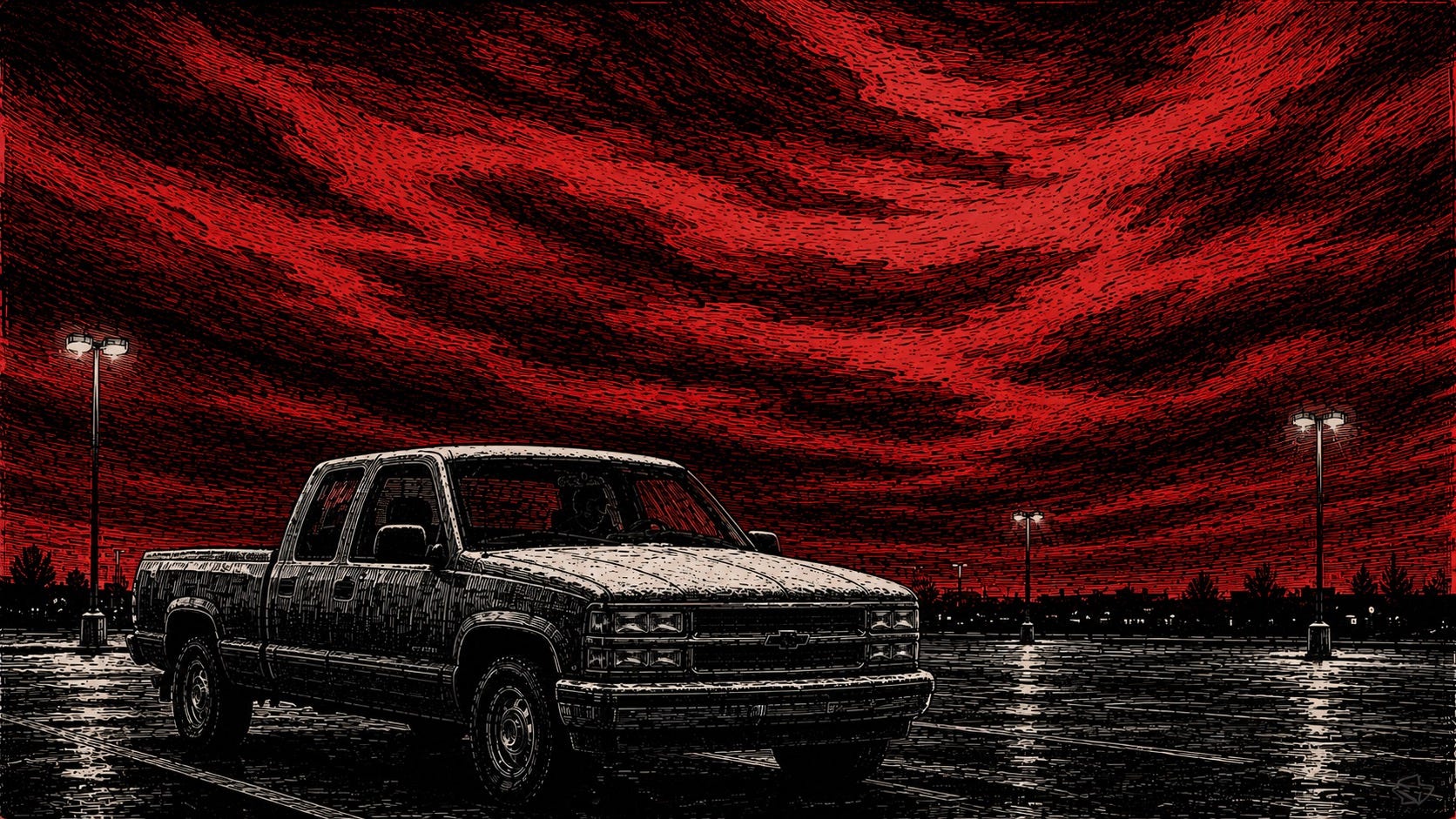
The truck was cold.
Earl Sutherland hadn’t noticed right away — he’d come back from the IGA with two bags of groceries, set the bags on the passenger seat, started the engine without thinking, and it was only when he put his hand on the steering wheel that he felt the cold in his palms. He’d left his gloves on the counter. Again.
Linda would have said something. Not a reprimand — Linda didn’t do reprimands, it wasn’t her style. Just a look. The kind of look that says you’re doing it again without saying you’re doing it again. Earl had spent thirty-one years learning to read those looks, and now that there were no more of them he left his gloves on the counter.
He let the engine run. Waited.
The IGA parking lot in Red Deer was half empty on this Thursday November evening. A few cars under the lampposts, a guy pushing his cart at the far end, the slush on the asphalt reflecting the orange light of the signs. Earl looked through the windshield without really looking. He did that more and more — settling somewhere and looking without seeing, engine running, hands on his knees, until something specific brought him back to the present moment.
Tonight, it was the sky.
He’d been watching the sky above the parking lot for a minute without knowing why. Not a beautiful sky — a city sky, November, dark since four-thirty the way it goes in Alberta in November. But something in the way the lamppost light hit the low clouds. A tint. Not orange the way it usually was, not the normal reflection of artificial light off cloud cover. Something paler. Flatter.
Earl had spent thirty years on oil rigs looking at the sky. Not for pleasure — for work. The sky told you things on the rigs: pressure dropping before a storm, frost announcing equipment problems, the too-bright winter light that meant cold below what the instruments were reading. He’d developed a way of reading the sky that had nothing poetic about it. Purely functional. The sky as measuring instrument.
And tonight, that instrument was telling him something he didn’t yet know how to name.
Setting the grocery bags on the passenger seat, he’d brushed the truck’s hood without thinking — a hand resting one second on the cold metal. He hadn’t thought about it at the time.
He drove home.
* * *
The house was a Red Deer bungalow Earl and Linda had bought in 1998 when the kids were still small — two bedrooms at the front, a finished basement, a double garage for the truck and the rig equipment. Since the kids had left — Stephanie to Calgary, Kevin to Edmonton — and since Linda was gone, Earl occupied the house the way you occupy a space that’s too large: moving always through the same zones, the kitchen, the living room, the bedroom, the garage, the same paths traced through the same rooms, the rest of the house closed like museum exhibits.
In the entryway, on the radiator, Linda’s mittens — knitted some winter he could no longer place, never put away since, never worn by anyone. He passed them every day without touching them.
He put away the groceries. Heated up a can of soup — not because he was hungry, because it was supper time and he’d learned in three years that if you didn’t eat at supper time you didn’t eat. Linda had always cooked. Not complicated things — good things, things that smelled like something when you came in the door. Earl had learned canned soup and sandwiches and occasionally a steak in the cast iron pan that he overcooked because he forgot to watch.
He ate standing up, leaning against the counter.
That was a rig habit — you ate standing up on the rigs, fast, between tasks. Linda had hated it. Earl, we’re at home. He’d sat down for thirty-one years because of that. Now he ate standing up because there was no one to say Earl, we’re at home.
After the soup he took his phone and went to sit in the armchair in the living room.
The armchair was his — had always been his, Linda had the couch, that was their natural arrangement, nobody had decided it. Earl in his beige armchair worn at the arms, Linda on the couch with her magazines. The couch was still there. Earl didn’t sit on it.
He opened the forum on his phone.
* * *
He’d joined the forum six weeks after Linda’s funeral.
Not out of desire for anything specific. Curiosity first — a curiosity he couldn’t have named, a curiosity that had always been there without ever having a direction. He’d typed words into a search engine one December evening, words he’d never typed in his life, and the forum had come up. VR Nomads 55+ — LGBTQ+ Friendly. He’d read for three weeks without joining. He’d signed up as prairie_earl_AB because it was descriptive and didn’t say much about who he really was.
Maybe that was enough to start.
He hadn’t been unhappy with Linda. That was important to say clearly, and Earl said it to himself without trying to make things into something they hadn’t been. He hadn’t been unhappy. But there had been, all his life, something carefully put away in a place he didn’t look at often, and now that he had time to look, he looked.
Linda had known. Not everything — Earl himself didn’t know everything, not clearly, not in precise words. But Linda had known that something in him had never had a place, and she’d chosen to build a life with him anyway, and Earl had never known if that was love or generosity or both or something else entirely. She had paid, without ever saying so, part of the price for what he had never known how to say himself. He’d grieved Linda sincerely. He still did. And he’d joined the forum. Both things were true at the same time, and Earl was used to complicated things that had to stay simple on the outside.
On the forum he’d posted a few messages. Mostly practical ones — questions about winter campgrounds, about winter tires for vans, about generators. People had answered. Men and women from all over the country, in vans or motorhomes, travelling alone or as couples. Earl found himself coming back less for the vans than for the men who drove them.
And then he’d posted about the sky.
It had started in September. He’d noticed the sunsets first — something had shifted in the colour, a white-yellow where there should have been orange. Then the morning light, that diffuse whiteness that wasn’t fog. Then the birds — the snow geese passing two weeks earlier than usual, as if something in the light was telling them a different date than the calendar. Earl had noted all of this without mentioning it to anyone. People in Red Deer weren’t the type to talk about the sky, except to complain about the weather.
He’d posted six days earlier. This is what he’d written:
prairie_earl_AB · 6 days ago
anyone else notice sunsets have changed colour since the summer? less orange. more white-yellow. here in alberta it’s like the sky lost something but i couldn’t tell you exactly what. snow geese went through two weeks early this year. crops around red deer were short this fall, farmers say it’s the summer heat but i don’t know. i’m not a meteorologist. i just spent thirty years outside on rigs and learned to pay attention to what changes. something has changed. just me or you seeing this too?
Twenty-two replies — most indifferent, some curious, none taking it seriously.
Until tonight.
* * *
Earl read the message from chimiste_libre twice.
chimiste_libre · 2 hours ago
What you’re describing is consistent with a modification of atmospheric diffusion spectra. If reflective aerosols are present at altitude — naturally or otherwise — shorter wavelength light scatters more, producing exactly this white-yellow tint you’re observing. I’m working on a surface sample collected last night in Medicine Hat. Nothing conclusive yet. But you’re right to look at the sky. — Raymond. Retired chemist. Sherbrooke, Quebec.
He read it a third time.
There was something in the way it was written — not condescending, not the type to explain the obvious. Just: precise. The man gave a mechanism, a hypothesis, and a concrete fact — the surface sample. A field chemist who had collected something. Earl knew people who collected samples — he’d been one for thirty years, soil samples, drilling fluid samples, gas. You collected when you thought there was something to find. You didn’t collect for nothing.
He had the strange feeling that someone had finally believed him.
Reflective aerosols.
Earl set the phone on the arm of the chair and thought.
He’d heard that term somewhere. An article maybe, or a radio program in the truck. The kind of thing you half-hear, file away without realizing it, and that comes back when something goes looking for it. Aerosols in the stratosphere. To reflect sunlight. To cool things down.
He thought about the storage tanks at the last rig he’d worked — a site forty kilometres northeast of Red Deer, which he’d left in 2022. The tanks sometimes developed a surface deposit after certain rains. A white deposit, slightly powdery. The rig guys called it road dust, cleaned it off and moved on.
Earl had never thought it was road dust.
Medicine Hat. Four hours to the southeast. On the same atmospheric trajectory, if the prevailing winds came from the west the way they almost always did in Alberta.
He opened the forum’s private messaging. Stayed there a minute, thumb above the virtual keyboard. He wasn’t a man of long sentences — he’d spent his life communicating through gestures, tools, physical presence. Written words weren’t his natural space.
He wrote anyway. Short. Direct. The question about the storage tanks, the deposit he’d seen, Red Deer on the same trajectory as Medicine Hat. Read it back.
He hesitated before signing — a hesitation he couldn’t have explained. Added his name at the end, the way the other man had.
Earl.
Hit Send. Maybe it was the first time in fifty years he’d written his own name, alone, to a stranger.
He didn’t know why he’d sent it privately rather than in the public thread. Yes he did. In the public thread there were the sun emojis and the people who said you’re imagining things. He wanted to write to the man who had collected a sample. It was simpler that way.
* * *
He put the phone down. Looked at the living room ceiling — the one Linda and he had looked at from this same living room for twenty-eight years. There was a small water stain in the left corner he’d never fixed and that Linda had mentioned twice a year. He still looked at it out of habit.
He got up to go to bed.
That was when his phone rang.
Not a notification — a call. The number on the screen: Stephanie, Calgary. He looked at the time: ten forty PM. Stephanie never called after eight unless something was wrong.
He answered.
— Dad.
Something in her voice. Not panic — Stephanie never panicked, she’d inherited that from him or from Linda, Earl didn’t know which. But something tight, contained.
— You okay? said Earl.
— Yeah. You?
— Yeah.
A silence. The kind of silence between a father and daughter who have learned to talk without saying much and who both know it should be different.
— I saw the news, said Stephanie. The thing about air quality in Alberta. The public health bulletin.
Earl frowned.
— What bulletin?
— Alberta Health issued an advisory tonight. They’re saying to avoid prolonged outdoor activity for the next few days. They’re talking about unusual atmospheric particulates. It covers the whole central zone — Red Deer, Calgary, Edmonton.
Earl said nothing for a moment. His eyes drifted to the living room window, to the truck in the driveway, to the hood he’d brushed with his hand earlier setting down the grocery bags.
— Dad?
— I’m here.
— You saw it?
— No, said Earl. I didn’t see it.
— They give any numbers? said Earl after a silence. Concentration levels?
— They don’t say. They say of undetermined origin.
Of undetermined origin. Earl knew that phrasing. On the rigs, it meant you knew or thought you knew but weren’t ready to say it officially yet. It was the language of preliminary reports, of people waiting to see which way the wind was going to blow.
— It’ll be alright, he told Stephanie. Thanks for calling.
— Alright? she repeated, and in that word was everything she wasn’t saying — the worry, the distance from Calgary, the dinners she’d suggested and he’d declined, the question she hadn’t asked since Linda’s death and maybe since before.
— I mean I’ll be careful.
— You’re all alone out there, Dad.
— I know.
— Kevin could come next weekend if —
— Stephanie.
— What.
— It’ll be alright.
She let a moment pass. Earl heard her breathing on the phone — his daughter in Calgary, thirty-nine years old, with her own kids now, calling her father at ten forty PM because she’d seen a public health bulletin and Red Deer is where he’s alone.
— O.K., she said finally. But you call me if anything changes.
— I’ll call.
— Promise?
Earl hesitated a fraction of a second — the hesitation of a man who has spent his life promising the minimum so he can keep what he says.
— Promise.
— Sleep well, Dad.
— You too, sweetheart.
He hung up.
* * *
He stood in the living room, phone in hand.
Unusual atmospheric particulates. Of undetermined origin.
He went to the kitchen, took an empty Folger’s can from the cupboard — old rig habits don’t leave — and went out the back door into the yard, leaving it open behind him.
The November cold hit his face all at once.
He ran his hand across the hood of the truck, parked in the side driveway. Rubbed gently. Looked in the faint light from the garage at what remained on his palm.
A nearly invisible powder.
He put it in the can. Sealed it. Went back inside.
Under the kitchen light, he turned his right hand over, palm up.
The skin at the base of his index finger was slightly red. He’d touched the hood earlier setting down the bags — one second of contact, no more. It had been too cold outside to notice anything at the time.
He looked at the Folger’s can on the counter.
Looked at his hand.
In the living room, his phone vibrated.
A forum notification: chimiste_libre replied to your private message.
Earl went and sat in his armchair. Opened the message. Read it.
He read it twice. Three times. Then he set the phone on his knee and sat very still, eyes on the water stain in the left corner of the ceiling, and he didn’t think about anything specific for a long moment — or rather he thought about everything at once, which came to the same thing.
The man from Sherbrooke had written one sentence at the end of his message, after the data, after the technical questions, after his coordinates:
My husband Michel — a nurse for thirty-one years — used to say the same thing about me.
Earl read it a fourth time.
Husband.
Not partner. Not spouse. Husband.
Then he closed his eyes.
END OF CHAPTER 2
* * *
🎵 k.d. lang — Constant Craving
An Albertan who came out an entire generation without ever naming it that way. The song is about a craving that never quite goes away, even after decades spent pretending it wasn’t there. Mark Romanek’s video — the same director who’ll later film Cash’s Hurt — has an austere elegance that suits this chapter of restraint and undeclared hope perfectly.