

Previously, on SONAR Fictions: Raymond, a retired chemist from Sherbrooke, has been driving west alone since the death of his husband Michel, in March. In Medicine Hat, he noticed an unknown deposit on his van and began corresponding, on a travelers’ forum, with a man named Earl — a retired Alberta oil-patch worker, a widower for three years, a man who’d spent his life keeping quiet about who he was. In his last message, Raymond wrote Michel’s name. And the word husband. Earl read it four times. Then he closed his eyes.
* * *
Drumheller, November 2026
Highway 1 ran west in a single flat line, between the harvested fields and a sky that wasn’t changing its nature — that same flat whiteness from Medicine Hat, tinged yellow now, as if the campground had never really ended. Four and a half hours, the app had said. Raymond had learned not to trust time estimates since Michel was no longer there to contradict them, from memory, and be right.
He stopped at the Husky in Brooks for a coffee he drank standing up, leaning against the van, in the half-empty lot. Took out his phone. The prairie_earl_AB thread had lit up again overnight — seven new replies since the Alberta Health advisory on suspended particulates. Glasgow, Montana. Saskatoon. Fort McMurray. Same deposit, same unanswered questions, four hundred kilometres apart from each other. This wasn’t a campground thing anymore. It was a region.
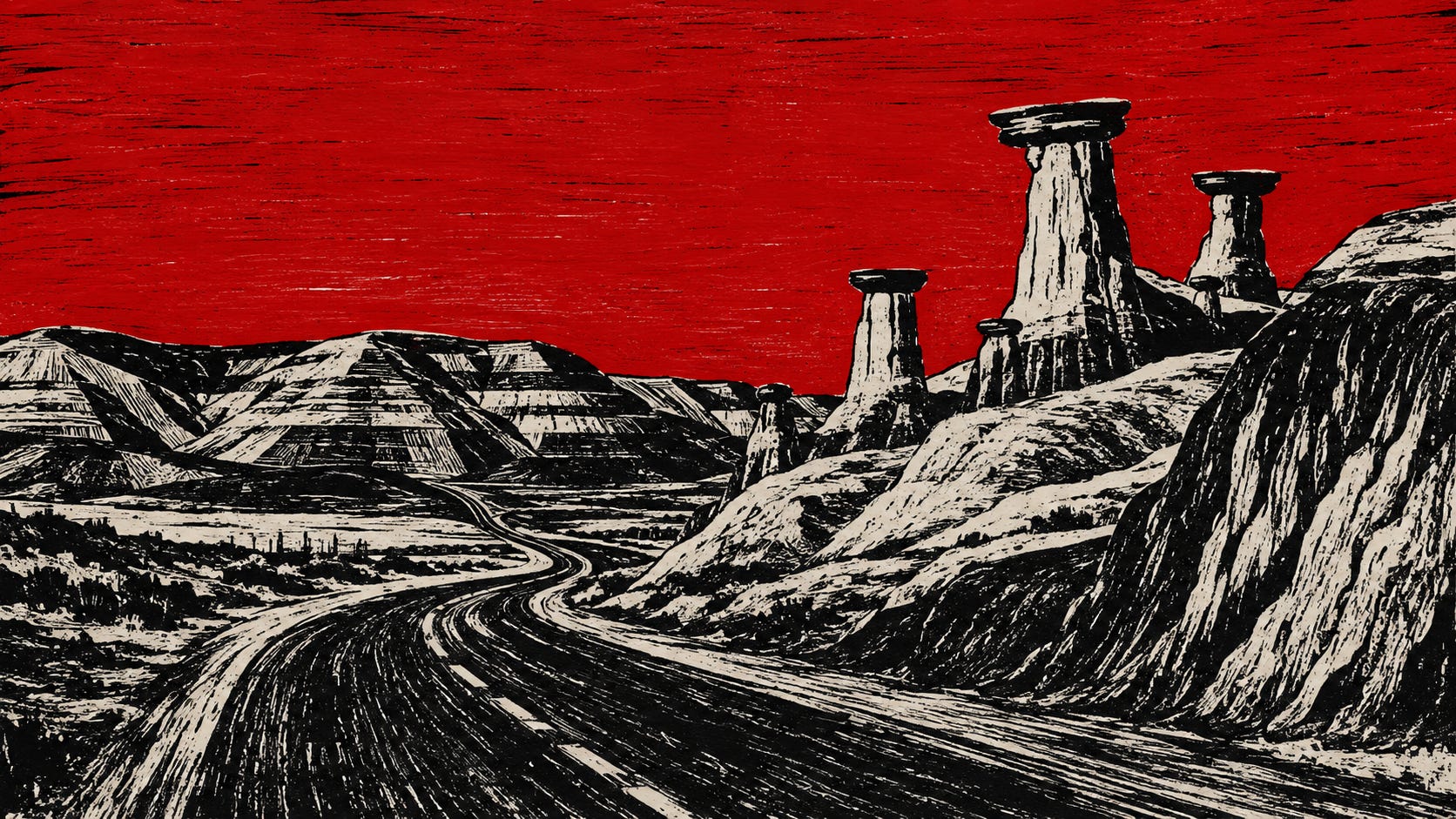
He got back in the van. The road dropped into the badlands without warning — a long ribbon of asphalt suddenly plunging into a landscape nothing before it had announced: striped hills, ochre and grey, carved on timescales that Raymond, professionally, knew how to name and still couldn’t quite grasp. Beneath the lower cloud layer clinging to the bottom of the valley, the sky recovered, for two or three kilometres, its ordinary colour — a pale blue, almost timid, as though something, here, had briefly forgotten to do its job. Then the road climbed back out of the layer, and the yellow-white closed back over it, as tight as a lid.
Michel would have loved this valley. Michel would have wanted to stop, take pictures, read the historical plaque about oil and fossils out loud. It was a conversation they’d had once, in February 2025, bent over a road map spread across the kitchen table — Michel tracing an imaginary route across Alberta with his finger, explaining, with the enthusiasm of a man who wasn’t a chemist and who always laughed a little before the end of his own sentences, as if he already knew the punchline, that oil was very old life, compressed, turned to black dust, and that the carbon pulled out of it ended up somewhere, in the air, doing something. We’re going to finish by moving, he’d said that day, with no apparent connection to what came before, one finger drifting toward the kitchen window. Raymond hadn’t understood right away that he was also talking about the sky — he wouldn’t really understand until here, on this road, with the word aerosol in his mouth.
He didn’t put the memory into words. He let it pass through, like a sheet of cloud, and kept driving.
The Drumheller municipal campground was nearly empty in November — three sites occupied out of the forty marked on the laminated map at the entrance, a covered cook shelter at the centre, a green metal picnic table with paint flaking at the corners. Earl had chosen this spot. Not his place. He’d written it plainly in his last message: We’ll meet at the campground. Not ready for the house yet. Raymond hadn’t asked.
He arrived in late afternoon, the light already slanting, gilding everything it touched — the hoodoos in the distance, sandstone columns each capped with a stone harder than the rest, standing upright by a logic the eye took a moment to accept; the green metal table; his own hands on the wheel.
Earl’s truck was already there, a white cooler sitting on the passenger seat, visible through the window. Earl himself stood near the cook shelter, a cap stained grey pulled low over his forehead. A bigger man than Raymond expected, shoulders still broad despite his age, the hands of a man who’d worked with them for a long time.
Earl came down toward him without hurrying. Held out his hand.
Raymond hesitated the length of a breath before taking it — not reluctance, more the brief vertigo of a man who’s spent a long time looking at a door from the outside and now has to decide whether he’s going in.
“Raymond.”
“Earl.”
A handshake. Firm, brief. No embrace — neither of them would have known how to start one. Earl had rehearsed three opening lines on the drive from Red Deer — and forgot every one of them the moment he saw the van turn into the lot.
“Found it easy enough,” he said instead.
“GPS. Easy.”
They stood there a moment, each sizing up the other without showing it, in the ochre light that wasn’t going to last much longer.
Earl had brought soup. He announced it without making anything of it — pulled a dented thermos out of the truck, set it on the metal table, lifted the lid. Split pea. Made the day before, in Red Deer, in a kitchen no one else had walked into in three years to cook anything that would fill the place with a smell. He didn’t put it that way. He said:
“Had some soup kicking around.”
That wasn’t true. Earl served both bowls with an almost ceremonious care, one hand under each. Raymond said nothing — but noticed, without putting it into words, that soup kicking around doesn’t get poured like that.
They ate under the cook shelter, a Big Rock beer for Earl, water for Raymond. The wind picked up in gusts, rolling between the rock formations with a different sound than the open Prairies — caught, held, released, as if the landscape itself was breathing in fits.
“Your thread woke up,” Raymond said, sliding his phone across the table. “Seven more replies since last night.”
Earl read, jaw tight, scrolling with a thumb too big for the precision of the gesture.
“Fort McMurray,” he said finally. “If the old-timers on the rigs up in Fort Mac have seen it, we’re behind on this by a fair stretch.”
“Four towns,” Raymond said. “Four hundred kilometres apart, minimum, at the same time. A deposit that travels like that isn’t local pollution. It’s a deployment.”
“Deployed by who?”
“I don’t know yet. But somebody knows why it’s falling the same way in Glasgow, Montana, as it is in Saskatoon. That’s not an accident.”
Earl set the phone down. Looked at his soup a moment without eating it.
“We’re not just two guys comparing roadside deposits anymore, are we.”
“No,” Raymond said. “We’re not just that anymore.”
After the meal, the samples came out — each their own, set side by side on the green metal, like two pieces of evidence in an investigation nobody had officially opened. Raymond’s Ziploc bag, labelled in his cramped handwriting: Medicine Hat, Nov. 4 2026, 6:00 a.m., left mirror. Earl’s Folger’s coffee can, empty of coffee for a long time, never labelled.
Raymond opened both containers on the table. Looked. Touched, with the tip of his finger, first his own sample, then Earl’s. Brought it to his nose for a fraction of a second, professionally, without thinking about it.
“Same texture,” he said. “Maybe the same substance. Maybe a family of related substances. I can’t confirm without a lab.”
“But you think so.”
“I think so.”
Earl nodded, once, the way you acknowledge a diagnosis you’d been expecting without wanting it.
Then he went back to the truck and returned with a black-covered notebook, stained with engine grease at the corners, its spine worn soft by twenty years of back pockets and dashboards. He opened it to a page marked with a faded yellow Post-it, still holding on more out of habit than glue.
“This,” he said, sliding the notebook toward Raymond. “September seventeenth, 2019.”
Raymond read Earl’s handwriting, dense, no flourishes, the handwriting of a man who wrote things down to remember them, not to be read:
Tanks 4 and 7. White powdery deposit, same as the rain on Sept 12–14. Standard cleanup. No WHMIS sheet applicable. Ask GZ. Follow-up: none.
“No WHMIS sheet,” Raymond repeated. “That means nobody, in 2019, had a protocol to identify what this powder was. No safety data sheet. No classification. Nothing.”
“That’s it exactly.”
“Who’s GZ?”
“Day guy. Left the company in 2020, if I remember right. Never heard back.”
“Seven years,” Raymond said, more to himself than to Earl.
“Didn’t put it together till this week. I just wrote it down. That’s how I’ve always done things. You write it down. It’s useful someday or it isn’t.”
Raymond closed the notebook carefully, as though he could still damage something that had already survived seven years in a glove box. He noticed, doing it, a slight redness at the base of his own index fingernail — the one that had touched the sample on the mirror, in Medicine Hat, bare-handed.
“This,” he said, showing his finger. “Since Medicine Hat. Won’t heal.”
Earl raised his own hand. The knuckle of his index finger was dry, almost white, as though rubbed too often against denim.
“Same here. Figured it was just winter coming on.”
“Me too, at first.”
They stayed a while with their hands open on the green metal table, adding nothing more. Two men who had touched the sky with bare hands, each on his own, hundreds of kilometres and seven years apart — and who both knew, now, that it wasn’t just winter.
They walked, once night had nearly fallen, along the Red Deer River, on a gravel path the campground kept up poorly. The sky went out by degrees into that yellowed white that had been following Raymond since Medicine Hat — a colour that didn’t resemble any dusk either of them remembered from their youth.
Earl talked about Linda in fragments, without warning, between silences.
“She made that soup every two weeks. Thirty-nine years. Counted once, for a laugh. Comes out to near a thousand times.”
Raymond said nothing. But something, in the word thousand, moved through his chest before he had time to name it — thirty-five years, himself, and no one left, now, to count the suppers in his place.
Earl stopped in turn, as though the path had handed him back a sentence he hadn’t summoned. You and your sky, Linda used to say, every time she found him outside watching the sunset too long. He never answered. He still didn’t know what to answer.
Further on, without transition, it was Raymond’s turn. Michel came back to him, one line only — A chemist who’s never wrong hasn’t tried hard enough — and this time Raymond no longer knew whether it was his own thought or Michel’s.
Neither one asked the other since when he’d known — known, for himself, for what he was, even before Michel, even before Linda. The question hung between them, as present as the gravel underfoot, and neither picked it up.
Earl caught his foot on a loose stone in the path, a small stumble, the kind a man usually catches on his own. Raymond put a hand on his shoulder — three seconds, maybe four, a steadying gesture, nothing more, the hand of one man keeping another from falling. Earl said nothing. Didn’t stiffen. Didn’t move either — and it was that stillness, more than the hand itself, that lasted.
Raymond took his hand back, as slowly as he’d put it there.
The dam was holding. And it wasn’t.
They walked back to the cook shelter without talking. Earl suggested, putting the empty thermos away in the cooler, that they sleep in their own vehicles, parked side by side on the gravel — the extended cab of his truck, seat reclined, and the sleeping bag he always kept behind the seat, an old Alberta winter habit. Raymond agreed without hesitating, with a relief he wouldn’t have admitted out loud.
At three in the morning, Earl woke to use the campground latrine, a small wooden building half-lit at the end of the lane. Coming out, he didn’t climb back into the truck right away. He stood between the two vehicles, in the dry November cold, head tipped back toward the sky.
The Milky Way was there, as always at this distance from any city — but paler than he’d ever seen it, a diluted streak rather than the dense river he remembered from his childhood in the Prairies, before the rigs, before Linda, before everything. He counted, out of the habit of a man who’d spent his life judging quantities by eye: fewer stars than before. A lot fewer.
He thought of August 2003 — a power outage that had emptied out the northeastern seaboard of America in one evening, millions of people in Toronto, in New York, in Detroit, stepping outside to see, maybe for the first time in their lives, what the sky over Cold Lake gave them every single night without their giving it a thought. The rig crews had laughed about that, come out of their trailers that night too, pointing up — not because their sky had changed, but because, for once, someone else was seeing what they saw all the time. Earl remembered it very precisely — the guys laughing, the coolness of the air, the rare feeling of witnessing something that belonged to everyone at the same time.
This wasn’t the same, tonight. Nobody had cut the power. Something, instead, had been added — poured, dispersed, somewhere above their heads, by people Earl didn’t know and never would, for reasons nobody had ever given him the right to understand.
Somebody made our sky paler, he thought, without the exact words, in that slower language he reached for only when something really mattered. And nobody told us.
He stood there a while longer, still, between Raymond’s van and his own truck, two vehicles parked side by side like two animals sleeping. Then he climbed back in without a sound, careful not to wake a man he’d known for six hours and who was already sleeping as though he’d known him far longer than that.
END OF CHAPTER III
— — —
Soundtrack for Chapter III
🎵 Townes Van Zandt — Pancho and Lefty
Two men. Two fates crossing paths. Two ways of staying faithful to someone who’s gone. Van Zandt himself used to introduce it as “a medley of my hit” — with that same bittersweet humour that’s exactly the tone of Drumheller. The Heartworn Highways version, solo guitar, in someone’s living room, is the right one. Raw. Alive.