

Previously, on SONAR Fictions : Raymond and Earl met at the Drumheller municipal campground. They compared samples — a seven-year-old work log confirming the same residue — and walked along the Red Deer River. At three in the morning, alone outside, Earl noticed the night sky had lost some of its stars.
* * *
Raymond woke to fog on the driver’s-side window, a brighter rectangle where his breath had melted the frost overnight. Twenty to seven. Earl’s truck was already running, idling, a thin plume of white exhaust rising into the cold air.
Earl knocked twice on the sliding door, no harder than he had to.
— Coffee’s made. Get in, we’re going where I’m thinking.
No explanation. Raymond grabbed his notebook, the sample bag left on the table from the night before, and climbed in.
The cab smelled of coffee, worn leather, a trace of diesel that never quite went away. Earl drove one hand on the wheel, the other resting on the gearshift even though the truck was automatic — a habit left over from some other vehicle, older, long gone.
— Where exactly are we going?
— Gravel road, twenty minutes out. There’s a pond. Used to hunt around there when I was young. If there’s anything to see, that’s where it’ll be.
Raymond didn’t ask anything else.
* * *
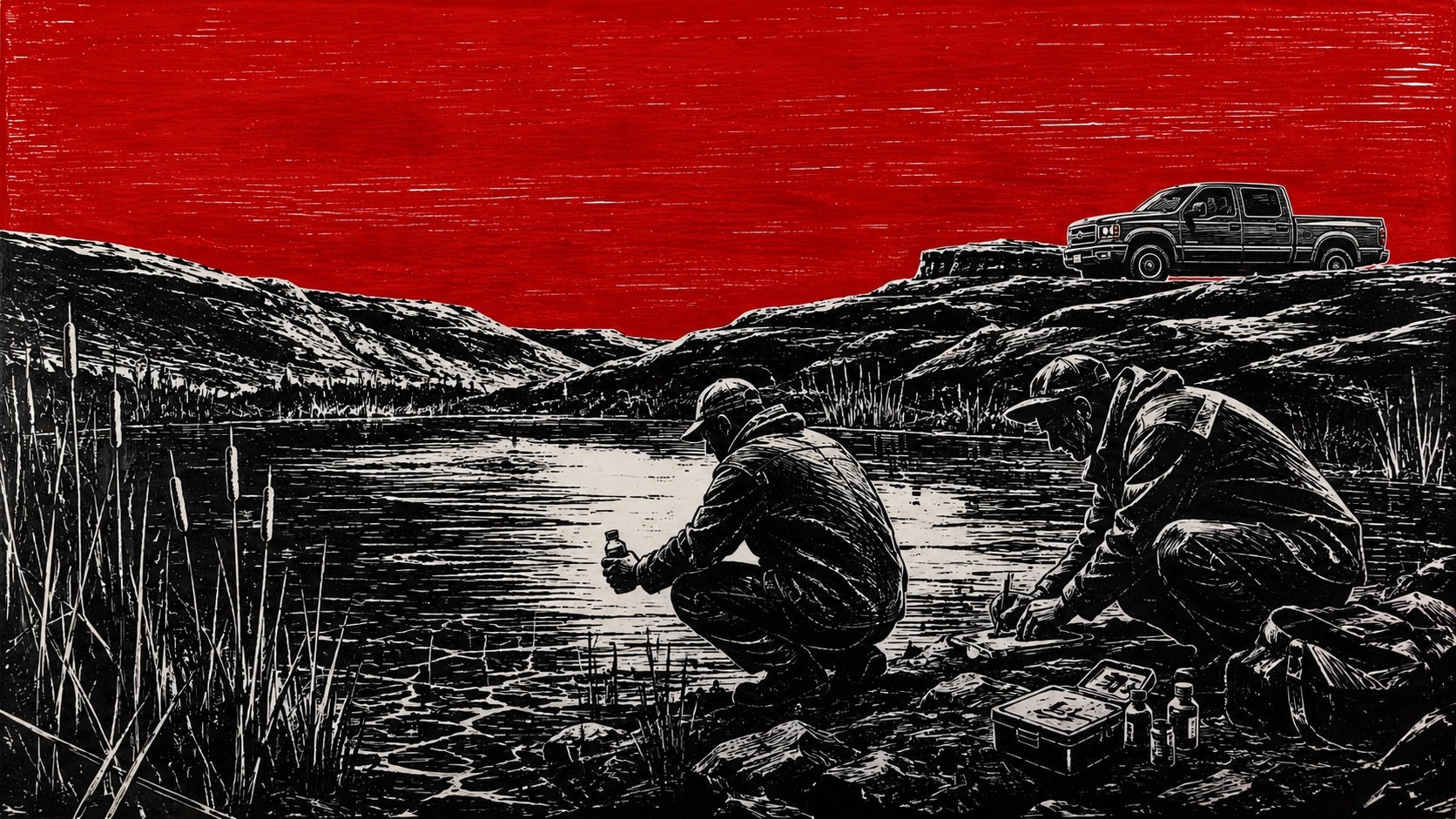
The pond sat between two rises, a still sheet of water fringed with yellowed cattails, smaller than Raymond had pictured. Earl cut the engine. The silence that followed had a particular texture — not the absence of sound, but the absence of one specific sound, which took Raymond a moment to place.
— No geese, Earl said, like he was answering a question someone had asked. This time of year, this spot, it ought to be honking up a storm in there. Listen.
Raymond listened. Just a sparrow, far off, and the wind moving through the cattails.
He crouched at the water’s edge and pulled an empty vial from his pocket. The surface carried a greenish film, almost oily, without the usual texture of an algae bloom — too even, too regular, more painted on than grown. He collected a little, sealed the vial, and labeled it in marker: date, approximate location, time.
Earl, crouched on the other side, was scraping at a lichen on a rock near the waterline with his thumbnail. Pale grey, almost white, where Raymond remembered — without knowing why he remembered it, an image rather than a fact — that prairie lichen usually ran toward orange.
— Is that supposed to be more colorful than that?
— Yeah. A lot more.
Raymond noted the discoloration without touching it. That kind of bleaching, in a lichen, had a name he knew without saying it out loud — a family of compounds he’d handled in the lab decades earlier, ones that turned into something else, something more corrosive, on contact with moisture. He said nothing to Earl about it. Not yet.
Earl broke off a fragment and slid it into a Ziploc-style bag, identical to Raymond’s — he’d brought a whole box of them, Raymond noticed, as if he’d known they’d need more than a few.
Michel would have photographed everything, before he even understood what he was looking at.
Raymond pushed the thought away without really pushing it away — it stayed there, at the edge, while he screwed the cap back on the vial.
They worked in silence for twenty minutes, each on his own side of the pond, meeting now and then to compare a sample, without much talk. It wasn’t an awkward silence. Raymond noted, without quite putting it into words, that it was the first silence between them that carried no weight.
* * *
The radio came on when Earl turned the key to get the heater running — CBC Radio One, low, left there from the day before. They were about to pull out when the newsreader’s voice shifted register, that particular flat, neutral tone reserved for official statements.
“The Government of Canada acknowledges that certain solar radiation management experiments have taken place on Canadian territory since 2019, as part of research projects conducted in partnership with international organizations. The Department of the Environment states that the exact scope of this testing is under internal review, and that no conclusions will be released before that process is complete.”
Nothing more. The newsreader moved on to the weather.
Neither of them spoke. Earl took off his cap and set it on his knees, no deliberate gesture to it — the way you do in a church, without thinking. Raymond looked down at his hands. The heater kept blowing, steady. Outside, the wind bent the cattails. The radio went on, another voice, another topic — traffic on the 2, somewhere around Calgary.
Earl didn’t turn the radio off. He kept his hand on the key, not turning it, the engine still idling in neutral.
Raymond looked at the vial of greenish water sitting between them on the bench seat.
— Seven years, he said, mostly to himself. Your notebook already said as much. We didn’t need them to confirm it.
— No.
A pause. Earl didn’t move.
— You carry a thing like that a long time before you find the words for it, Raymond said, his voice lower, not entirely sure anymore if he was still talking about the sky.
Earl said nothing for a moment. The heater kept blowing.
Earl kept his hand on the key, not turning it. His knuckles whitened, for a second, no more.
— Me too, Earl said. I mean — I’ve spent my whole life like that.
He wasn’t looking at Raymond when he said it. He was looking at the radio, or at nothing, his gaze fixed somewhere past the windshield. Raymond said nothing back. There was nothing he could say that wouldn’t, in the saying, force me too to mean only one thing.
Earl turned the key. The engine started.
* * *
The drive back happened almost without a word, but it wasn’t the morning’s silence anymore. Earl drove a little slower than he had on the way out.
At the campground, Raymond’s van was waiting where he’d left it, alone on the nearly empty lot. Earl pulled up beside it and left the engine running.
— I need to get this to an old colleague, Raymond said, lifting the bag of vials. A chemist. Reliable. He’ll know what to do with it, how to document it properly.
— Where’s that?
— Sherbrooke. I have to head back that way anyway.
Earl nodded, hands on the wheel.
— You’ll let me know what he finds.
— I’ll let you know.
— If it’s something — Earl stopped, started again — once you know what it comes to. I’ll come down.
It wasn’t a question. Raymond didn’t treat it like one.
— You’ll come down.
Neither of them said anything more specific. No date, no route, no promise put into words that would have made it more fragile by making it bigger. Raymond got out of the truck and closed the door. Through the window, he raised a hand, brief. Earl raised his, barely.
The truck backed up, turned, disappeared down the campground entrance road.
* * *
Earl drove to Red Deer without turning on the radio.
In his driveway, engine off, keys still in his hand, he sat for a moment without getting out. The house in front of him still had its blinds closed from when he’d left. No one to have opened them.
He took out his phone. Found Stephanie’s name in his contacts, thumb hovering above it.
You and your sky, Linda had said once, laughing, watching him scan the horizon for nothing. You never lied, Earl. You just never said everything. That’s not the same thing.
He sat with his hand on the phone, not moving, like a man waiting for something inside him to make the decision for him.
He started a text instead — easier, he thought, than a voice that might shake. Stephanie, I need to tell you — He deleted it. Started again. Stephanie, I’m heading out to — Deleted that too.
Through the windshield, the evening sky was only just beginning to darken over the neighborhood rooftops. He glanced up at it, for a second, without really looking — a reflex now, since September. Now that the radio had said it out loud, the sky was exactly the same color it had been the day before. Nothing had changed, except what Earl knew, looking at it.
He closed the text field. Dialed the number instead. His thumb stayed above the call button, not pressing.
He sat in the cooling truck, composing in his head a sentence he didn’t yet know how to finish.
END OF CHAPTER IV
* * *
🎵 Brandi Carlile — The Story
▶
Carlile is openly queer, openly country, openly political. This song is a cry — not of anger, but of accumulated truth finally spilling over. It’s about a face that stops hiding what it’s carried for years. Everything we’ve kept hidden ends up written there eventually. This is the chapter where both stories — SRM and coming out — break at the same moment. The song builds exactly like that.