

Previously, on SONAR Fictions : Earl and Raymond collected samples near a pond outside Drumheller. On the radio, the government of Canada acknowledged the existence of solar radiation management trials conducted since 2019. Earl answered with two words that didn’t quite say what they were answering to — Me too. Back in Red Deer, he tried to call his daughter Stephanie, without managing to finish the gesture.
* * *
Earl sits in the truck, engine off, in the driveway of his garage in Red Deer. The house is in front of him, dark, no lights on. He doesn’t go in right away.
He looks at the phone sitting on the passenger seat, next to the Folger’s can he still hasn’t emptied. He dials Stephanie’s number. He hangs up before the first ring. He dials again.
— Dad.
— Stephanie.
A silence. Not an awkward silence — a silence that’s waiting.
— You never call on a Tuesday night, she says.
— Got something to tell you.
She doesn’t answer right away. Something in the way he said it — slower than usual, almost careful — makes her tighten her grip on the phone. Earl looks at the house, the kitchen window, the black rectangle where Linda used to leave a lamp on even in summer.
— I’m heading out to Quebec, he says. Tomorrow, or the day after. Going to meet someone.
— I know, Dad, she says, softer than usual.
— You don’t know who yet.
— I know, she says. I’ve always known, Dad.
Earl closes his eyes. He doesn’t ask since when. He doesn’t ask how. There are questions you ask to learn something, and there are questions you ask only to put off the moment you no longer have the right to turn back. This one belongs to the second kind, and Earl knows it well enough to let it go.
— Mom knew too, Stephanie says. She never talked to me about it. But I know she knew.
— I know.
— It’s okay, Dad.
Two words. Earl takes them the way you take something too hot to hold — quickly, then you set it down, then you pick it back up again because you have to carry it somewhere eventually.
— What’s his name, Stephanie asks.
— Raymond.
He doesn’t add anything. She doesn’t ask for more.
* * *
Four days later, Earl’s truck pulls up in front of a triplex on rue de Vimy, in Sherbrooke. Raymond heard it from the kitchen before he saw it — that six-cylinder rumble with a muffler that should’ve been replaced two years ago, the same sound that had been in his ears the whole drive out to the pond, a few days before. He’d have recognized it anywhere, now. He doesn’t go to the window. He finishes wiping his hands on his apron and waits for the doorbell.
Earl fills the doorway, too big for the frame, his body still stiff from the road, like part of him was still driving. He’s wearing his work boots, the same ones from Drumheller, and he looks at them for a moment on the hardwood floor of the entryway before taking them off, without being asked.
— Nice place you got, Earl says.
— It was ours, Raymond says.
The extra word hangs between them for a second. Earl doesn’t apologize. Raymond doesn’t take it back.
Earl moves into the living room like a man visiting a place he isn’t sure he has the right to look at. He stops in front of the bookshelf — Michel’s books, sorted by language and then by subject, because Michel read philosophy between shifts in palliative care and never threw anything out. Earl runs a finger along a spine without opening it. That one, I really need to reread someday, Michel used to say, about once a year, in front of the same title, without ever rereading it.
On the small table by the entrance, a stack of mail waits, higher than it should be. Underneath a grocery store flyer, an envelope from the Ordre des chimistes du Québec, never opened, addressed to R. Lemieux. Earl sees it. He says nothing. Raymond sees him see it. He says nothing either.
On the kitchen wall, a calendar is still open to March.
* * *
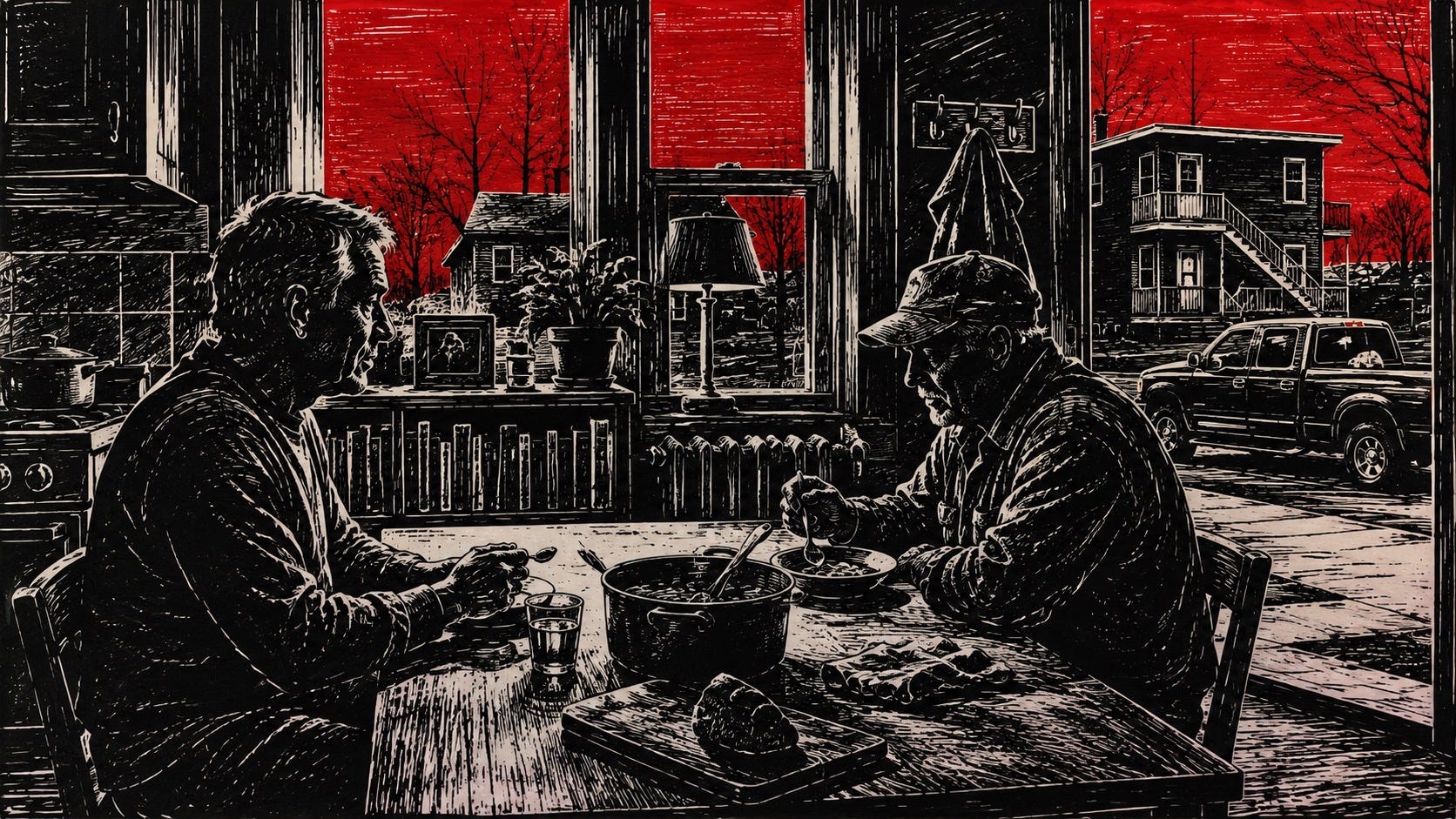
Raymond had made a stew — something that takes a long time to cook, so he’d have something to do with his hands while he waited. The smell filled the kitchen — browned onion, thyme, the veal stock Michel always made himself and froze in portions, never from a cube. One last portion had been left, right at the back of the freezer, and Raymond had pulled it out that morning without thinking. Raymond had forgotten the house could smell like that. It was a dish Michel loved, one he used to order almost every time they went to his mother’s, before. Raymond hadn’t made it since March. He tastes a spoonful, standing at the stove. It tastes exactly the same. It tastes completely different.
They eat at the kitchen table, not in the dining room — Raymond never fixed the legs on the third chair after it broke, last fall, and he never replaced it either. Two chairs had been enough. They still are.
Earl eats slowly, like a man tasting something new who doesn’t want it to show. He says it’s good. He doesn’t say too much thyme, but Raymond hears it anyway, in his head, in another voice — too much thyme, again — and he smiles without explaining why. He watches Earl’s hands around the fork — the same hands that had scraped at a lichen with a fingernail, a few days before, thousands of kilometres from here.
Earl gets up, goes to rinse his plate at the sink. He picks up the bar of soap sitting on the ledge to wash his hands, without thinking about it, without knowing whose it had been. The smell, ordinary, drifts through the kitchen for a second.
After the meal, Earl stays standing in the kitchen longer than he should, just breathing.
— Smells good in here, he says, not knowing what he’s saying.
Raymond stops, hand on the counter. He goes still a second too long, without knowing why, then wipes down a pot that didn’t need it and changes the subject.
Raymond takes a kraft envelope from the bottom drawer, received earlier that week, one he hasn’t opened in front of anyone yet.
— My colleague looked at our samples, he says.
He spreads the pages out on the cleared table. Earl comes closer, hands in his pockets, like a man who doesn’t dare touch a document he doesn’t understand.
— Sulfur dioxide, Raymond says. A family of particles used for cooling, in theory. The problem is, it doesn’t stay sulfur dioxide. On contact with moisture — rain, skin, anything wet — it turns into sulfuric acid. Not enough to burn. Just enough to irritate. Dry out. Redden.
He takes Earl’s hand without asking, turns the wrist toward the light, thumbs at the cracked skin over the knuckle.
— That, he says. That’s it.
Earl looks at his own hand like it belongs to someone else.
— And yours? he asks.
Raymond raises his own hand, the nail on his index finger still marked with a red line that hadn’t faded since Medicine Hat.
— Same.
They stay like that a moment, the two hands almost touching under the light, neither of them quite making the move to close the gap.
* * *
Earl sleeps on the couch. He’s the one who suggested it, before Raymond had to figure out how to.
The couch is the same beige as the one in his own living room back in Red Deer — the one where Linda used to spend her evenings with her magazines, the one Earl hasn’t sat on since October 2023, without ever deciding not to. He touches the armrest before lying down, one second, the way you touch an electric fence to check it’s off.
On the other side of the hallway, Raymond isn’t sleeping either. The sheets on Michel’s side have been cold for eight months. They’re still cold tonight. It’s not worse than usual. It’s not better either. It’s exactly the same, and that, maybe, is the first thing that’s changed — that it should be the same, on a night when there’s someone else in the apartment for the first time since March.
In the dark, Raymond thinks of a short phrase of Michel’s, one that surfaces without his looking for it: Don’t be back too late. Michel used to say it for nothing — for a run to the grocery store, for an evening out with colleagues from the lab. Tonight the phrase comes back with no one in particular to receive it, and Raymond lets it hang in the room without trying to work out who, now, it might be meant for.
* * *
In the morning, Raymond hesitates half a second in front of the top cupboard — the one where Michel’s favorite stoneware mugs still sit, never given away, never used since March. He opens it anyway. He pours the coffee into two mugs before he’s even heard Earl get up — a gesture he hasn’t made in eight months, done again without thinking.
He rinses his hands before picking up the mugs. There’s still a little lather worked into the soap — a bubble bursts under his fingers, one he wasn’t looking for. For one second, just one, he’s in another kitchen, thirty years earlier, and it’s Michel laughing at something Raymond can no longer hear.
The two mugs steam quietly on the counter. The smell of Michel’s soap. Coffee soaked into the walls after thirty years of mornings. A day late, he understands what had stopped him, the evening before, at the counter. He stays a second too long, palm still damp, before shaking it off.
Earl comes into the kitchen in his socks, his hair flattened on one side. He takes the mug Raymond hands him. His fingers brush Raymond’s wrist in passing — a fraction of a second, maybe unintentional, maybe not.
Raymond doesn’t pull his hand away.
Outside, rue de Vimy is white under a November sky that’s neither overcast nor clear, a flat yellowish-white that Raymond now recognizes everywhere he goes, in Sherbrooke same as in Medicine Hat. He says nothing about it. There’s nothing left to say about it, not since the announcement. The silence about the sky has changed meaning without changing shape.
Earl looks out the window, the mug in both hands.
— I’ll have to go back, he says. Not just yet.
— No, Raymond says. Not just yet.
Neither of them says what not just yet means, in hours or in days. They drink their coffee, standing, in Michel’s kitchen, and for now, that’s enough.
END OF CHAPTER V
* * *
🎵 Johnny Cash — Hurt
▶
A cover of the original composition by Trent Reznor (Nine Inch Nails, 1994), recorded by Cash in 2002.
Cash was seventy-one when this video was filmed. He would die seven months later. June Carter appears in it too, watching him — she would go before he did. This isn’t a song of despair: it’s the clear-eyed reckoning of a man no longer telling himself any stories. That’s exactly where Raymond is, closing the door on that kitchen.