

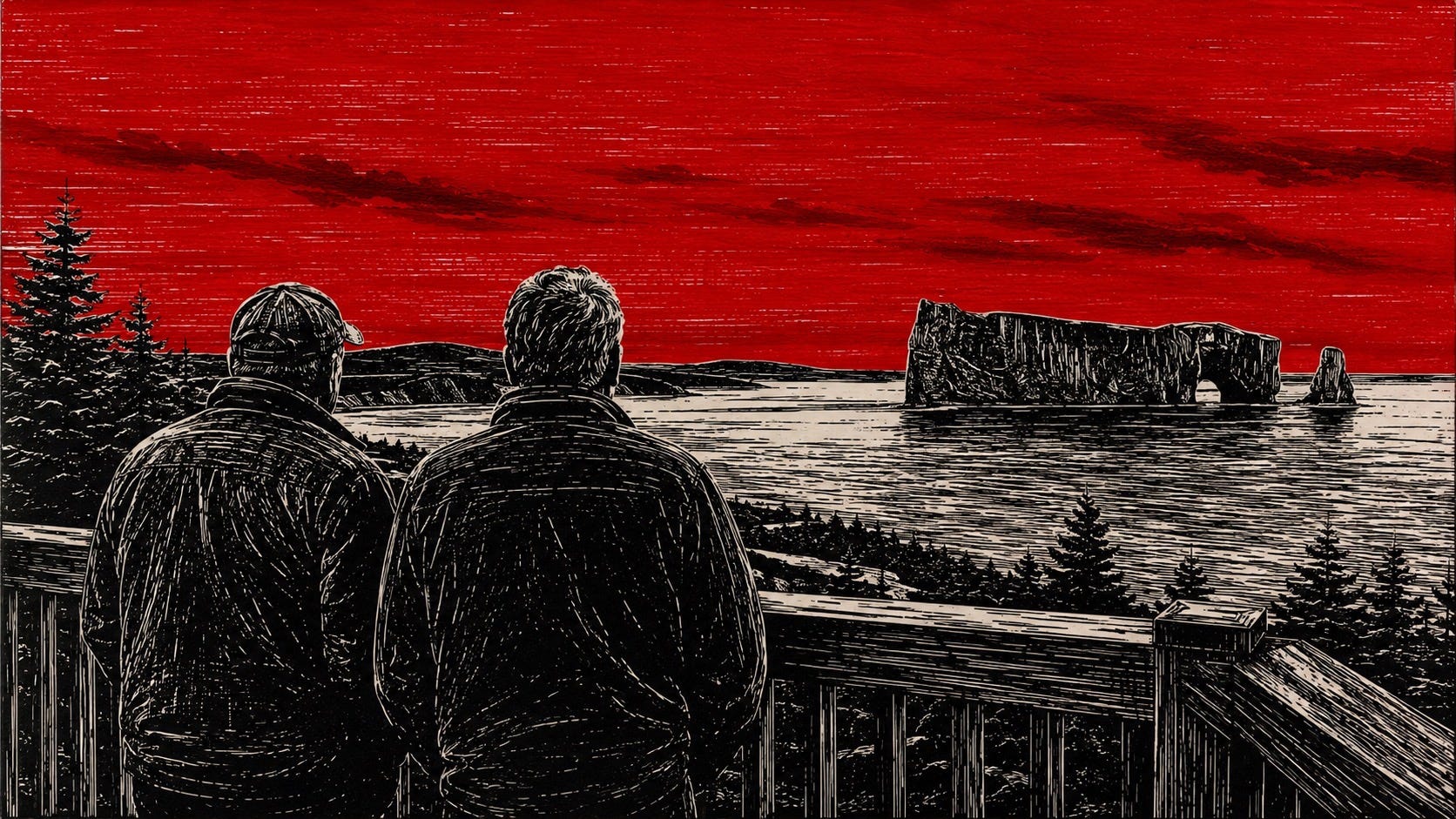
A year, almost to the day, after leaving Sherbrooke alone for the first time, Raymond arrives in Percé by Route 132, hugging the coast, late in the afternoon. Earl follows behind in the pickup, the way he has for this whole last stretch of road since Trois-Rivières. They no longer need to arrange meeting points on a forum; Earl just follows, and Raymond, rather than watching the landscape go by, checks the rearview mirror every so often to make sure the headlights are still there, a little behind, at the same distance they’ve kept for hours.
They’ve each kept their own vehicle — Earl his pickup, Raymond his van — less for lack of room than by a tacit agreement: each keeps a place of his own, even after all this time.
The village shuts down early in October. The few restaurants still open post full or closed signs, and that suits them fine: neither one wants a dining room, a menu, a server who’d ask where they’re from. They park at the belvedere, in the nearly empty lot, the two vehicles side by side the way they do now without thinking about it, and they eat sitting on the pickup’s bumper — bread, the cheese Earl likes and that Raymond buys now without having to remind himself, a handful of olives picked up on impulse in Rimouski. Earl passes half a sandwich to Raymond without a word, and Raymond takes it without a word either — a gesture that, a year earlier, would have called for an apology just for existing. Earl watches Raymond chew, long enough that Raymond looks up and meets his eyes, and they stay like that for a second before both turning toward the water.
The rock appears to them one last time before night falls completely — a dark mass at the far end of the bay, barely denser than the sky darkening around it. Neither says anything. They watch it disappear into the dark the way you watch something you know you’ll find again tomorrow.
Earl says it’ll be cold tonight, and climbs back into the pickup without shutting the door right away — the window stays half down.
— Motel by the wharf’s got rooms, he says. Saw the sign coming into town.
That’s not a question either. Raymond searches his memory of the year for one single night either of them proposed this — Drumheller, Medicine Hat, Rimouski, always the two vehicles, never a bed shared unless the lack of anywhere else forced it. He can’t find one. Nothing tonight is forcing it.
— Good idea, Raymond says.
The room smells of electric heat and a carpet that’s seen plenty of passing travellers. A bed, a bedside lamp, a curtain that doesn’t quite close over the parking lot. Neither says that after a year, after all those nights kept apart by a few metres of asphalt, this is the first time they’ve slept under the same roof. There’s nothing to say about it.
Earl turns off the lamp. Raymond, in the dark, no longer has a mirror to check, no distance to measure between two headlights — only the weight of Earl settling into the mattress, and then, almost right away, his warmth crossing the cold sheet between them. Raymond doesn’t move toward him. He stays on his own side of the bed, feeling that warmth gain ground on its own, without his having to make a move for it. Earl falls asleep first, almost at once — his breathing changes, thickens, then a light snore sets in, uneven, entirely without grace. Raymond listens to it for a while in the dark, and doesn’t hear a flaw in it. He doesn’t need to move closer, or to quiet the sound: it’s enough that Earl is asleep, right there, for the whole room to change what it means. Outside, the wind picks up a little; in here, the radiator ticks against the wall, and Raymond falls asleep in turn, without having had time to think about it for long.
* * *
A year ago, Raymond left Sherbrooke alone. This morning, he wakes up in the motel room, the light still off, Earl asleep beside him — a novelty in itself, after all this time, not waking up alone.
It’s still dark. He gets up without turning on a light and fills the thermos — the one he bought to replace Michel’s original, lost somewhere between Trois-Rivières and Quebec City over the course of the year, same model, same rust colour. The coffee pours in the dark, without a sound. He doesn’t wake Earl, who sleeps on soundly. Unlike Drumheller, nearly a year before, it isn’t one vehicle parked next to another this time — it’s a bed, a room, a shared wall, and no one had to suggest it twice.
Outside, the air grips him all at once — the real cold of October in the Gaspé, not a discomfort, a cold that wakes you up, that confirms you’re here, alive, present in your own body. Raymond breathes it in once, twice. He’s known this air since before Michel — a summer at fifteen, a motel room in Percé with his parents, his mother saying the sea smelled of iron. He hasn’t smelled it in almost fifty years, and he recognizes it anyway — it still carries the dust that never quite leaves.
The door of the room opens. Earl steps out in his boots, no jacket, as if he’d decided the cold wasn’t his problem this morning.
— Coffee, Raymond says. Not a question.
— Yeah.
They walk to the edge of the belvedere, two steaming cups, unhurried. The rock is still a black mass against a sky just beginning to lose its night — not red, not yet, something between the two with no simple name. Below, the St. Lawrence makes no waves here — it makes a steady sound, a breathing too large to belong to any living thing, that started before them and will go on after. Somewhere to the left, a gull cries, then another, before it’s properly light out.
Raymond drinks a mouthful. The taste brings back nothing specific — except that the last time he drank coffee alone, standing, outside, in the cold, it was against the side of the van in Medicine Hat, a year before. He’s not alone anymore. That’s all the coffee teaches him, this morning.
The rock slowly pulls itself out of the dark. This impossible mass, riddled by time, capped with layers harder than the rest — the same stone, elsewhere, a few million years younger than the badlands’. It’s been losing matter forever. A section collapsed into the river over a century ago. Another will fall someday, no one knows when. It goes on being Percé Rock by losing, every year, a little more of itself.
Earl says nothing for a while. Then:
— Changes fast, the morning, out here.
— The sky’s always done that, Raymond says. It’s just that before, nobody was looking this close.
Earl nods, and there’s no telling whether he took the line as a remark about the light or about something else. Raymond doesn’t clarify. There’s nothing left to clarify, not since last year. The silence about the sky has changed meaning without ever changing shape, and this morning, like every morning since, neither of them needs to bring it up again for it to stay true.
Earl looks at the sea for a long time, without saying anything.
— They’re not gonna stop, he says finally. Nobody wants to be first.
— No, Raymond says. We opened the tap all the way. We’re not steering the flow anymore.
Raymond looks down at the river, which never stops moving. He thinks — without saying it, because there’s no one to say it to, except maybe himself, in the silence of the morning — that the human species took a long time to understand it controlled almost nothing of what happened over its own head, and that it went ahead and touched it anyway, groping, like an apprentice who never saw the sorcerer work the whole trick through, and who now has to keep going, alone, without knowing where it stops. There’s no real way back anymore, he understands, except toward worse. This isn’t an enemy they’re facing, here, on this railing. It’s a choice someone else made, somewhere, one day, for everyone at once — and that now has to be carried, for lack of a better one.
The light rises all at once, the way it always does at the last moment, after all that time when it seemed not to move at all. The rock turns grey, then ochre, then something not far from the colour the badlands had at five in the afternoon, a year before, a continent away.
— Still beautiful, Earl says.
He turns to Raymond, for a second, before looking back out at the water. He doesn’t say what he means. The still contains everything — the sky that isn’t quite the same anymore now that they know what’s been done to it, the years spent holding the line, the two men they weren’t supposed to become. Still, in spite of everything. Still, all the same.
The dimness draws back around them, slowly, while Earl’s hand finds Raymond’s on the railing, without looking, the way you find something you knew was there. Raymond doesn’t move. The two hands stay, resting on the cold railing, while the day finishes rising.
Neither says anything. The rock keeps eroding beneath them, imperceptibly, the way it always has. The river keeps its sound going. The gulls have gone quiet, or maybe no one can hear them anymore, now that the day is fully up.
The world, below, stays immense — the river swallowing more carbon than it should be able to hold, the rock, the sky that no longer quite belongs to anyone. On the cold railing, Earl’s hand stays on his.
THE END
“It is an unpalatable truth that unless we can succeed in greatly reducing CO₂ emissions we are headed for a very uncomfortable and challenging climate future, and geoengineering will be the only option left to limit further temperature increases.”
— Professor John Shepherd, Chair, Royal Society Geoengineering Study (2009)
Author’s Note
This story uses solar geoengineering as a work of speculative fiction. Its true subject lies elsewhere: what become of love, grief, and hope when the world itself enters an age of transformation.
At its heart, it is the story of two men who learn to love again.
Mary Gauthier — Mercy Now