

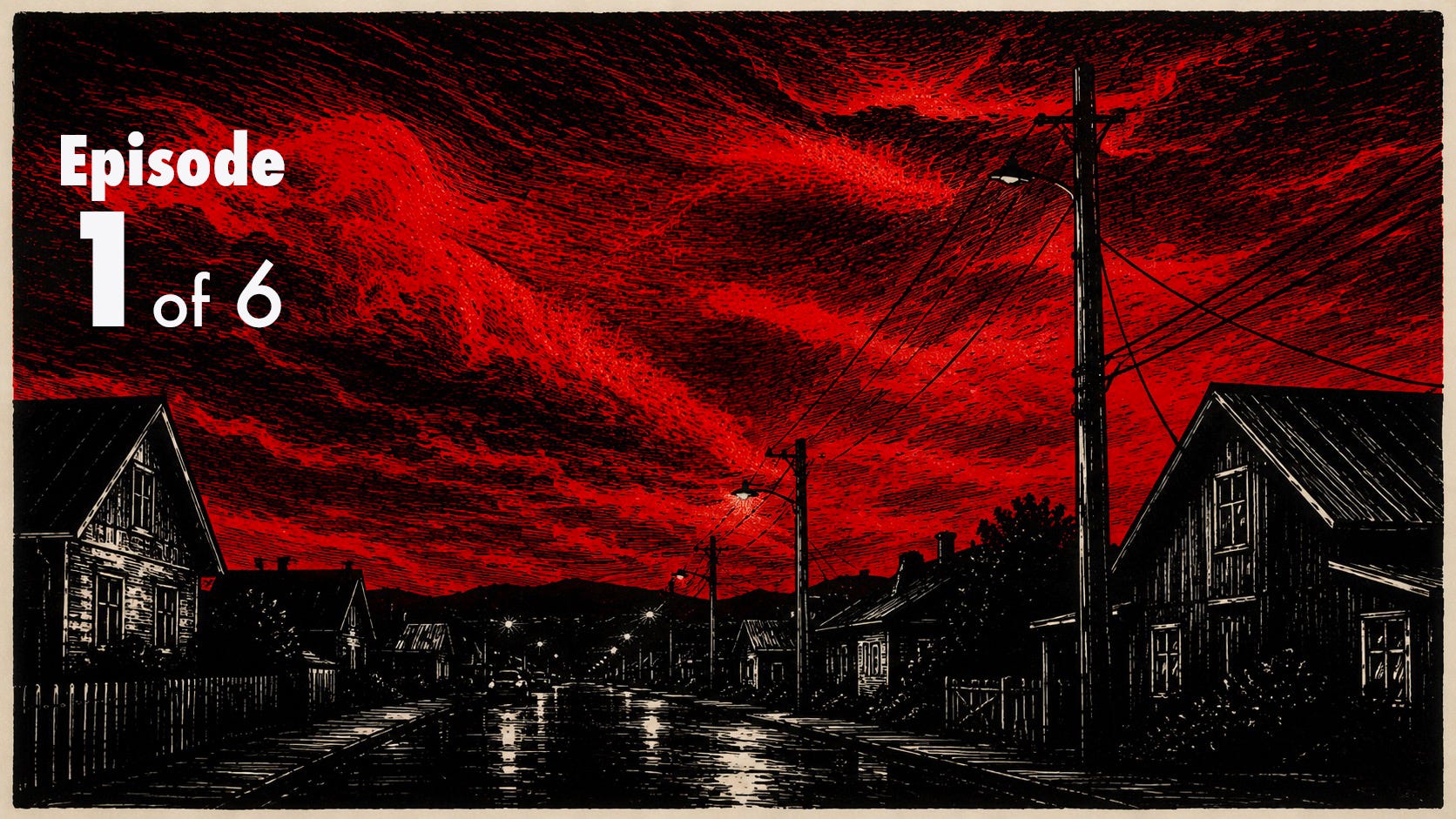
Chapter I · Raymond
Medicine Hat, November 2026
The rain had started around three in the morning.
Raymond wasn’t sleeping — he hadn’t really slept since March, not continuously, not without waking two or three times reaching for something beside him that was no longer there. He’d heard the first drops on the van’s roof, that light and irregular drumming sound he’d loved since childhood, and he’d thought: Michel would have liked this. Then he’d thought of something else, because he had to.
He got up at five forty. The Medicine Hat municipal campground was quiet — a dozen vehicles scattered across the wet asphalt, mostly retirees, people pushing south before winter made it impossible. Raymond set the water to boil on the small kitchenette burner, dressed in the November cold — the van’s heater took time in the mornings, Michel always turned it on ten minutes before getting up, Raymond had forgotten to do it and now he was cold, cold the way you get cold when you forget the things the other person did without you ever noticing they were doing them.
He opened the van’s rear door to get some air.
That was when he saw the deposit.
Not frost — he knew frost, its hexagonal crystals, the way it caught the light from the campground’s lampposts. Not dew either, too cold for November, too flat. Something else: a thin whitish layer, slightly crystallized, covering the bodywork in a uniform matte. A surface that should have reflected the campground lights and was absorbing them instead. Raymond stepped out in his socks onto the running board — one second, just enough — and dragged his index finger across the metal. Rubbed gently. Looked at what remained on his skin.
A nearly invisible powder. Slightly oily.
He went back inside, made his coffee, sat at the two-person table with his one-person cup, and thought: sulphate, maybe. Something in that family.
He was a chemist. Thirty-two years as a consultant to pulp mills in Quebec — not big chemistry, industrial chemistry, processes, material balances, incident reports. He knew how to read an unknown substance by texture. His professional nose had told him something outside: a faint mineral smell, almost metallic, that ordinary rain didn’t leave behind. He didn’t have the tools to analyze it here, in this Medicine Hat campground at minus four degrees. But he had memory.
He drank his coffee — still too strong, he still hadn’t learned to make coffee for one — and looked through the van window at the other vehicles in the campground. Same deposit on all of them. A white Winnebago motorhome belonging to an Ontario couple — he’d seen them the evening before, the woman with a pug on a leash, the man in a fishing hat in November. An Alberta pickup with a tent trailer at the back. Two or three small vans like his. All of them coated in this white matte that was not snow.
What is that? Michel always said those three words quietly when something seemed off. Thirty years as a nurse had taught him that before worrying, you looked, then you described. Conclusions came after. Raymond heard him still, as if Michel were sitting across from him, a steaming cup of coffee between his hands.
Something in him recoiled, half a second, before the chemist regained the upper hand.
Raymond took a Ziploc bag from the drawer under the bunk — he always kept a supply, old field chemist habit — and went back out. Pulled the van door shut behind him to keep the heat in. Carefully collected, with a coffee stirrer, a sample from the deposit on the left side mirror, where the concentration seemed densest. Sealed the bag. Went back inside.
He stood there a moment, the bag between his fingers, looking at this nearly invisible white powder in the van’s light.
Then he opened his laptop and wrote an email to the general contact address at Health Canada.
He knew they wouldn’t answer.
He’d known it before he started typing. Health Canada’s general contact address led to an automated form that led to an acknowledgement of receipt that led to silence. He’d sent emails to government bodies his entire career and he’d learned to tell the difference between addresses that reached a person and addresses that reached a system. This one reached a system.
He sent it anyway.
Michel would have insisted. Send it. You never know.
It had been Michel’s idea. The van.
Not Raymond’s. Raymond had never been a road man — he was a lab man, a reports man, a procedures man, the same mug in the same cupboard for thirty years. Michel was the other kind: the kind who studied maps for pleasure, who clipped articles about campgrounds in the Maritimes, who had opinions about camper vans before they had any reason to own one.
We spent our whole lives staying quiet, Michel had said one February evening in 2025, the two of them at the kitchen table in Sherbrooke with a glass of red wine each and snow falling outside. We’re going to finish by moving.
They’d bought the van the following autumn. A used 2021 Pleasure-Way Tofino, sixty-eight thousand kilometres on the clock, one previous owner who’d taken it to British Columbia twice and was letting it go reluctantly for health reasons. They’d spent the winter fitting it out — solar panels, memory foam mattress, under-bunk storage, the small two-burner stove Michel had chosen after comparing twelve models for three weeks with a seriousness that amused Raymond because Michel almost never cooked at home.
In the van I’ll cook, he’d said.
Why in the van?
Because in the van, we won’t be able to order Swiss Chalet.
Raymond had laughed. Michel had laughed. They’d ordered the stove.
The departure was planned for October 2026. Michel had retired in June 2024 — thirty-one years as a nurse at the CHUS, emergency first, then palliative care the last ten years, what he called the medicine of truth with a mixture of gravity and gentleness that was exactly what he was. Raymond had taken his in 2022, earlier than planned, because the pulp mill that had kept him for twenty years had just been bought by Toronto interests who had different ideas about what constituted a necessary consultant.
They’d annotated the maps together. Planned the stops. Talked about the Prairies.
You know what fascinates me about the badlands? Michel had said, finger on the map. It’s not the dinosaurs. It’s what they became. The sea recedes, species disappear, bones become stone — and bodies, they become oil. The world changes its nature, Raymond.
— It never stops. Something always keeps going… in another form.
He’d looked up from the map.
— You and I, we continue too.
Raymond hadn’t answered. He was a chemist — he knew exactly how kerogen becomes crude oil, what pressure, what heat, how many millions of years. He also knew what that oil became next: CO₂, heat, a sky coming apart at the seams. The transformation didn’t stop at the pump. It continued, invisible, in the atmosphere above their heads.
Raymond had looked down.
To continue.
As wood becomes ash. As snow becomes water.
But their love?
Michel had said nothing more.
In November 2026, parked at the lookout above the South Saskatchewan River, Raymond was thinking back to that evening. About almost everything, Michel had been right. Raymond would have wanted to be able to tell him so, still.
In March 2026 — seven months before their planned departure — Michel had his stroke.
A Tuesday morning. At home. Raymond was at his desk checking the weather forecasts for their route — he’d taken to this habit since they’d started planning, consulting the forecasts the way you check that the road is still there — when he heard the dull sound from the kitchen. Not a loud sound. The sound of someone sitting down on the floor without deciding to.
Everything after that had been very fast and very slow, and Raymond retained from that period only a series of discontinuous images: the paramedics in the hallway, the fluorescent light of the CHUS emergency room — the one where Michel had spent twenty years —, the doctor speaking in precise words that Raymond heard perfectly and couldn’t assemble into meaning, and later the room, and later still the silence of the apartment.
Michel died on a Thursday evening in March. Quickly, at the end, which was a mercy, the doctor had said. Raymond had nodded as though mercy were something he was capable of receiving at that particular moment.
He had waited six months.
On October 14th he had started the van.
Not because he was ready. Not because it made sense. Because Michel had said we’re going to finish by moving and Raymond couldn’t see any other way to honour that than to move, even alone, even without knowing toward what, even with Michel’s annotated maps spread across the passenger seat like a presence that wasn’t one.
He had checked the tire pressure in Magog.
The day passed the way days had passed since March: slowly and too fast at once, filled with small gestures that took twice as long as they should because Raymond still calculated for two before catching himself. He bought groceries at the IGA in Medicine Hat — a can of soup, bread, cheese, one apple, because Michel was the only one who ate them and he’d bought a whole bag the first week and watched them soften one by one before he understood. He filled the diesel tank. He cleaned the van’s windshield at the station squeegee — a mechanical motion, both hands on the wiper — and had the sudden absurd thought that Michel would have made a joke about the windows being cleaner than the bodywork now.
He laughed. Alone, at a Medicine Hat gas station, both hands on the squeegee.
It still happened.
Around seven that evening he drove to the lookout above the South Saskatchewan River and parked facing the water. The sky above Medicine Hat was white — not cloudy, not overcast. White. That flat, depthless whiteness he’d been noticing since Magog, since the morning he’d left Sherbrooke with Michel’s annotated maps, Michel’s thermos, Michel’s planned route, and the life Michel was no longer there to live with him.
He took out his phone. Found the forum. VR Nomads 55+ — LGBTQ+ Friendly. The thread from prairie_earl_AB, posted six days earlier: Anyone else notice sunsets have changed colour since the summer?
Raymond read the thread three times.
Signed up under the name chimiste_libre.
Wrote his reply — atmospheric diffusion spectra, reflective aerosols, last night’s sample — and added at the end, after a moment’s hesitation: Raymond. Retired chemist. Sherbrooke, Quebec.
Hit Send.
Placed the phone face down on the passenger seat.
There was a Post-it note in the glove compartment.
Raymond had known it was there since Magog — since he’d opened the glove compartment looking for the insurance documents and found it, Michel’s handwriting, that blue ballpoint he always used, the letters slightly right-leaning as though they were in a hurry:
Check tire pressure past Montreal — The Prairies are long.
He’d put it back without really reading it. Had closed the glove compartment. Had looked straight ahead at the 10 toward Montreal and driven two hours without thinking about anything in particular.
He hadn’t opened the glove compartment since.
That evening, parked at the lookout above the river, Raymond opened it.
Took the Post-it between two fingers. The paper slightly warped. The ink barely faded at the edges. The letters in a hurry — Michel who always seemed pressed for time even when he wasn’t.
Check tire pressure past Montreal — The Prairies are long.
Montreal was two thousand kilometres behind him now. He was in Medicine Hat, with a Ziploc bag of white powder on the table and a message on an internet forum that no one had yet taken seriously.
He put the Post-it back in the glove compartment.
The phone vibrated.
prairie_earl_AB sent you a private message — 11:14 PM
Raymond read Earl’s message once. Twice. Looked through the windshield at the black sky above the river. Read it again.
He thought about several things at once, which hadn’t happened since March: the texture of the deposit under his finger, Red Deer on the map — four hours to the northwest —, the question Earl had asked without quite asking it, Michel who would have said answer him tonight, Raymond, not tomorrow morning.
He turned his right hand over, palm up, under the van’s light.
The redness on his index finger had been there since morning. He’d noticed it without really registering it — a field chemist accumulates small skin irritations, it goes with the work. But tonight, under the light, it seemed more extensive than at dawn. Slightly warmer to the touch.
He looked at the Ziploc bag on the table.
Looked at his index finger.
Looked at Earl’s message on the screen.
He began to write his reply to Earl.
Outside, in the quiet Medicine Hat campground, something felt different.
Raymond looked up.
The sky was the same.
The one looking at it was not.
END OF CHAPTER I
Soundtrack for Chapter I
🎵 Colter Wall — Sleeping on the Blacktop
From Saskatchewan, fittingly. An old man's voice in a young man's body — low, slow, dusty. The Prairie road without destination. Silence as a permanent condition. The song of a man who drives so he won't have to stop, and who knows exactly why.